2,280 words, 12 minutes read time.
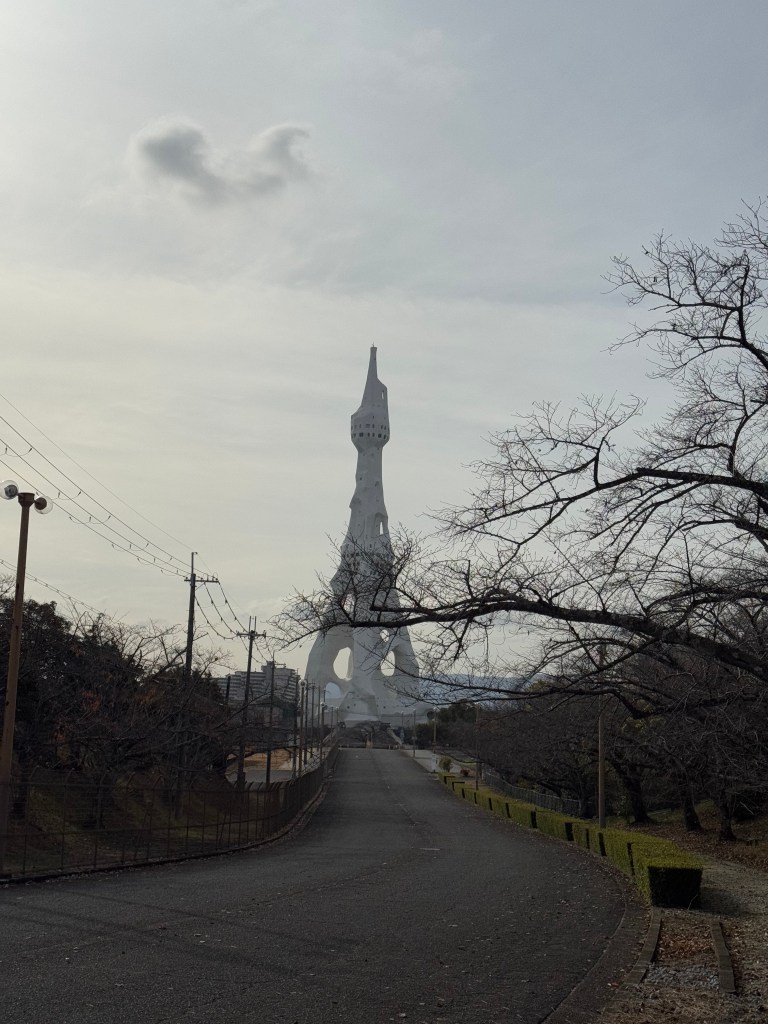
PL Kyodan
Like many other New Religions, the Perfect Liberty Kyodan (パーフェクト リバティー教団) aka PL Kyodan in the recent decades has had its number of believers dwindled. This may have to do with their main creed –“Life is Art” (人生は芸術である), which sets them apart from all the still relevant and so-called “For-old-lady” (おばあちゃん向け) religions which strive on door-to-door solicitations. PL is more ideological and passive, a result of which is its declining local relevance. The huge chunk of decorated land that the PL Kyodan still sits on is a reminiscence of its glorious past, but barrenness its reality.
Driven by sheer curiosity, I ventured alone into its grounds.
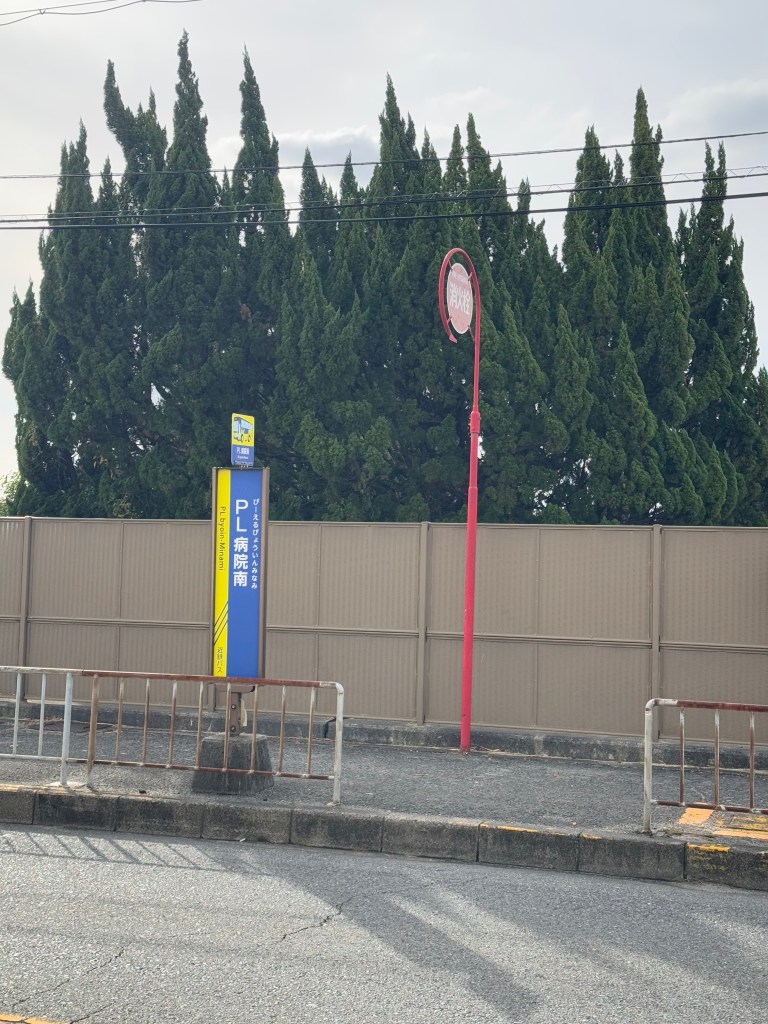
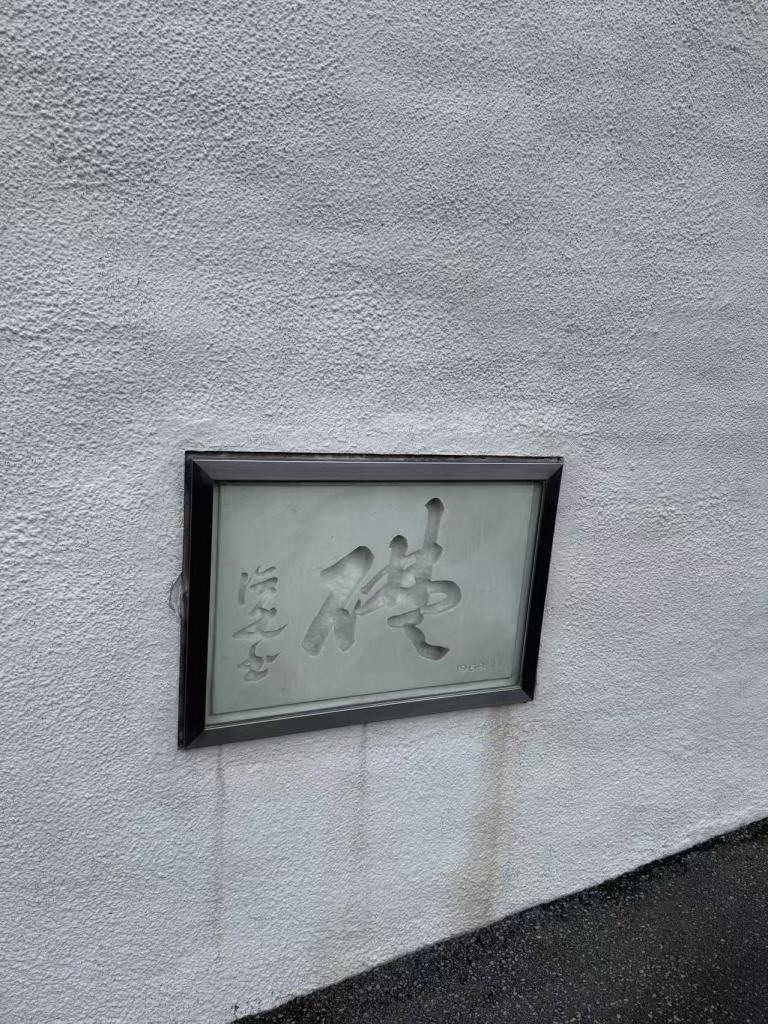
Much unlike Bentenshu, the PL Kyodan campus was fairly accessible. I took a bus from Tondabayashi station and got off at the PL byoin-Minami, i.e. PL hospital-South (PL病院南) bus station. PL hospital was a local hospital owned and run by PL Kyodan, the same for an enormous golf course engulfing the area. On the back side of the PL hospital was a grass plain, with the main building of PL Kyodan sitting solemnly on one end. There was a guard post before its campus, and I decided to not try my luck getting closer to it. Across the road stood the place that had captured my interest for several months — the PL Tower (PLタワー). That wasn’t its original name, though; its full, much longer title (as seen in the photo below) literally translates to something like: ‘The Great Cenotaph Tower for Peaceful Prayers to Console the War Dead of All Nations and Religions’ (超宗派万国戦争犠牲者慰霊大平和祈念塔).
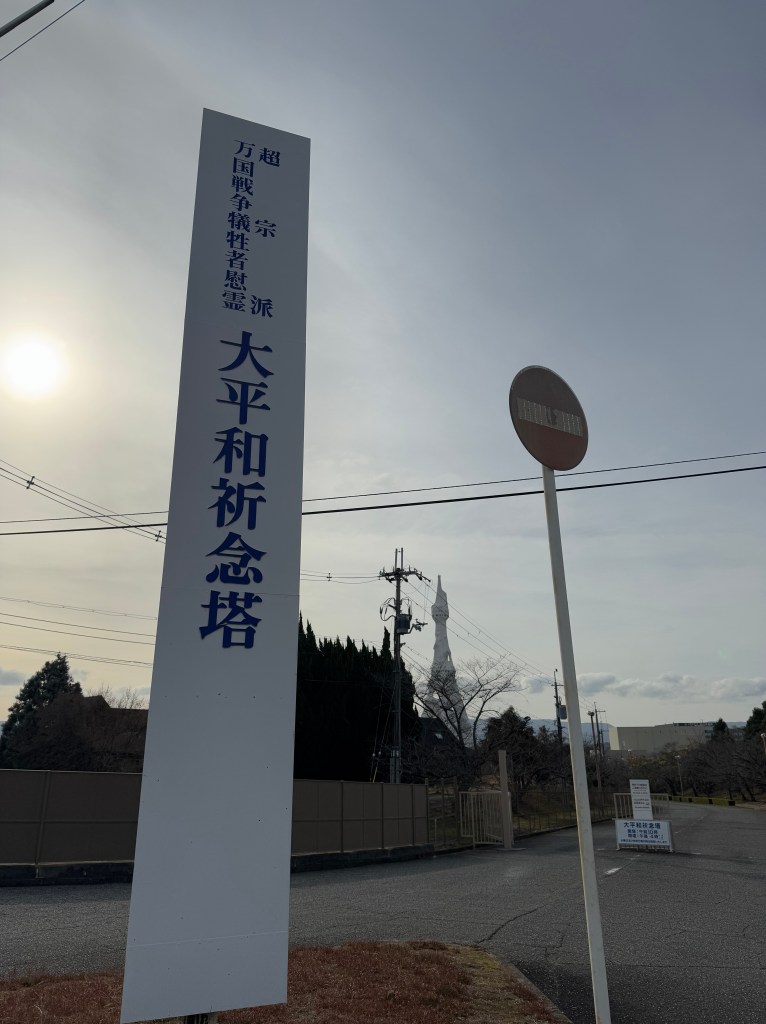
PL Tower
The PL tower was open to public. It opened six days a week from 10:00 A.M. to 4 P.M., and I arrived that day at about 10:15 A.M. The exterior of the tower was designed by PL Kyodan’s second leader Tokuchika Miki, eldest son of Tokuharu Miki, the founder of the predecessor of PL Kyodan.
At the size of of perhaps a dozen football fields, the tower grounds seemed completely empty. I was the only living soul walking around the park, and took my sweet time strolling around… I love strolling around places where I’m completely alone. It feels weirdly comforting and safe.
It was a cool Autumn morning, breezy but not windy. The sun hung low in the sky, glowed dimly, and veiled by a thin blanket of clouds that diffused its radiance across the sky.
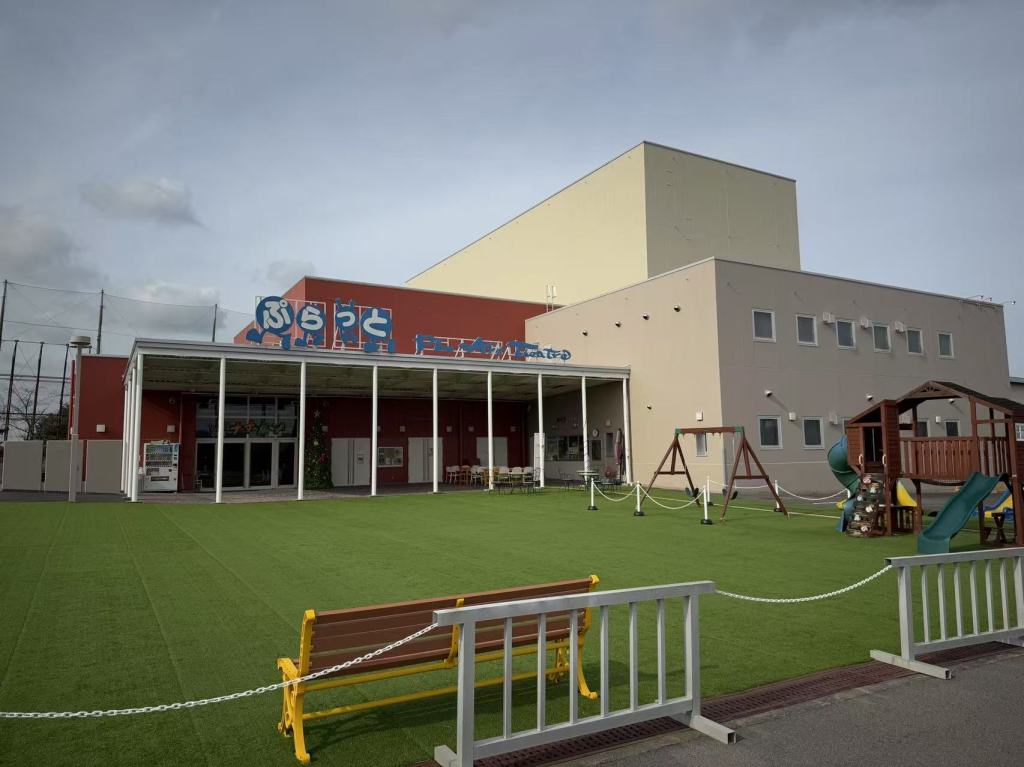
I walked pass a children’s theatre, which was located inside the park. There were several cars parked there, but no one was getting in or out. I wondered if their owners lived in the villas (PL Kyodan housings) that were in the tower grounds as well.
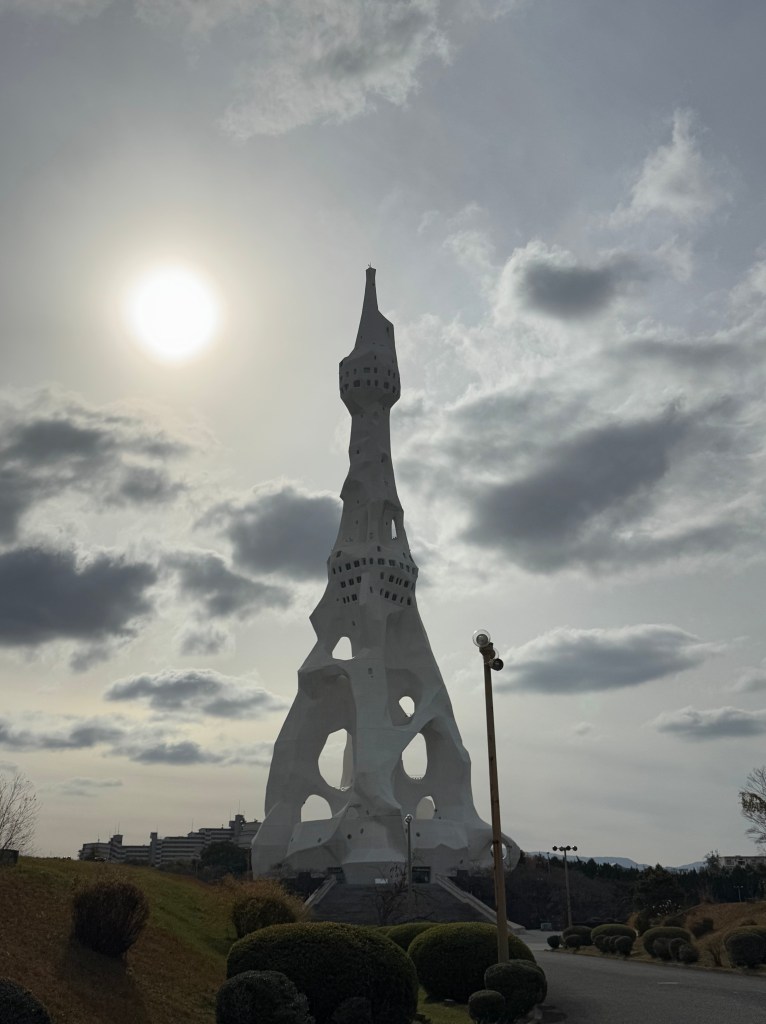
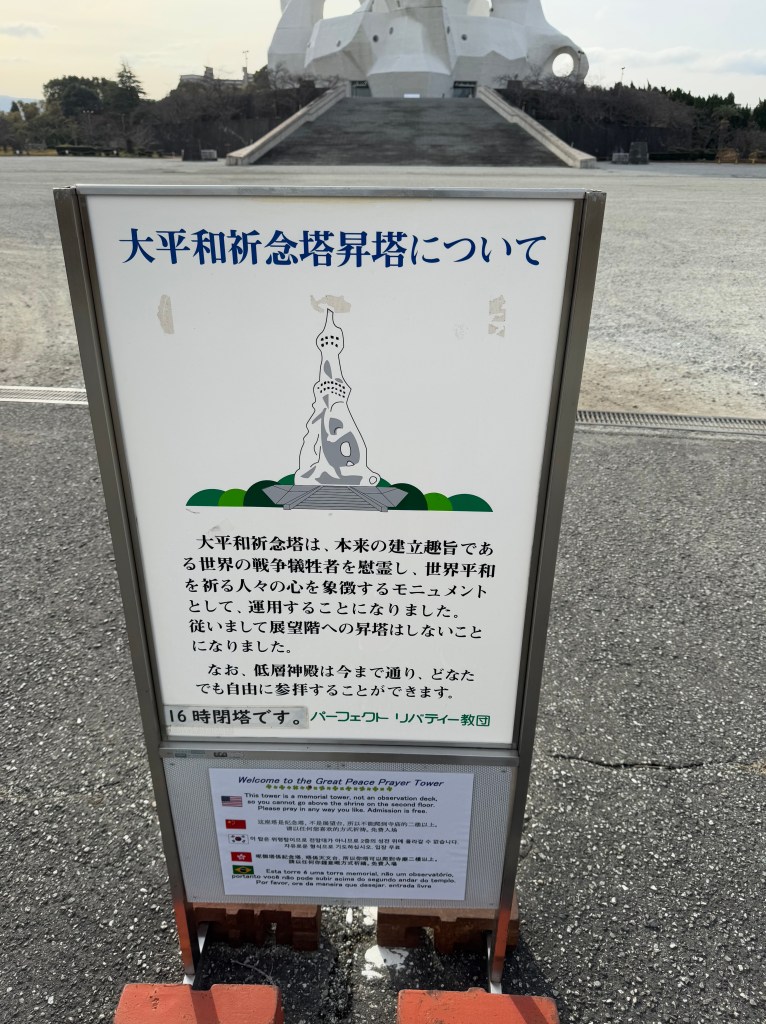
After a 10-min walk from the entrance of this campus, I came to the front of the tower. There stood a sign.
“About the Great Peace Prayer Tower’s Elevation
The Great Peace Prayer Tower was originally intended as a monument to honour and console the spirits of war victims worldwide and to symbolize the hearts of those praying for world peace.
As a result, the elevation to the observation floor is no longer conducted.
However, visits to the lower-floor prayer hall remain available, and anyone is free to worship there.
The tower closes at 16:00.”
—–Perfect Liberty Kyodan
The Square
There was a sizable square right in front of the tower stairs, surrounded by greenery and a dozen one-to-two-meter-tall stone statues of abstract shapes. The right size of the tower grounds seemed to be a PL-owned golf course, separated and veiled by tall-growing lush trees. I could hear distant voices coming from there, there seemed to be people playing.
I wondered around square and found that the statues seemed to be from the same Japanese sculpture symposium that was held in the year 1963.
As I was strolling around and taking photos of the sculptures and the tower, I heard the sound of a vehicle: a white truck drove from the entrance around to the square, then disappeared round the back of the tower, where a Do Not Enter sign stood. All the while I tried to act inconspicuous, but being the sole soul on the square, I was sure registered by whoever was on the truck. I felt a bit nervous. The autumn wind blew strong.
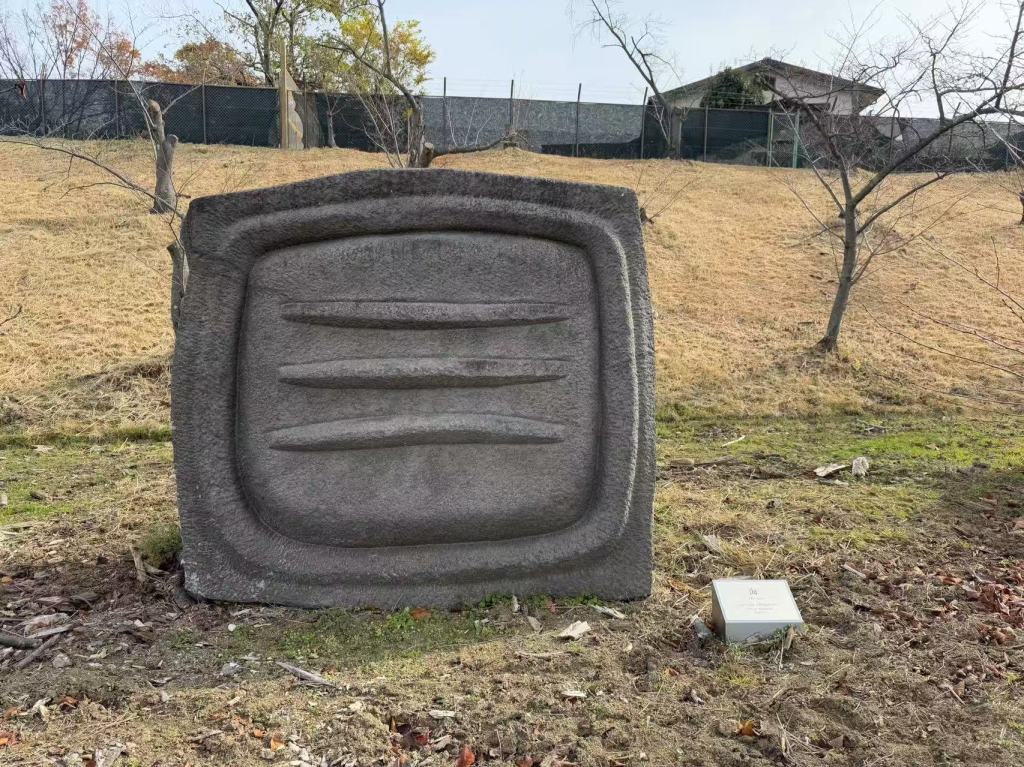

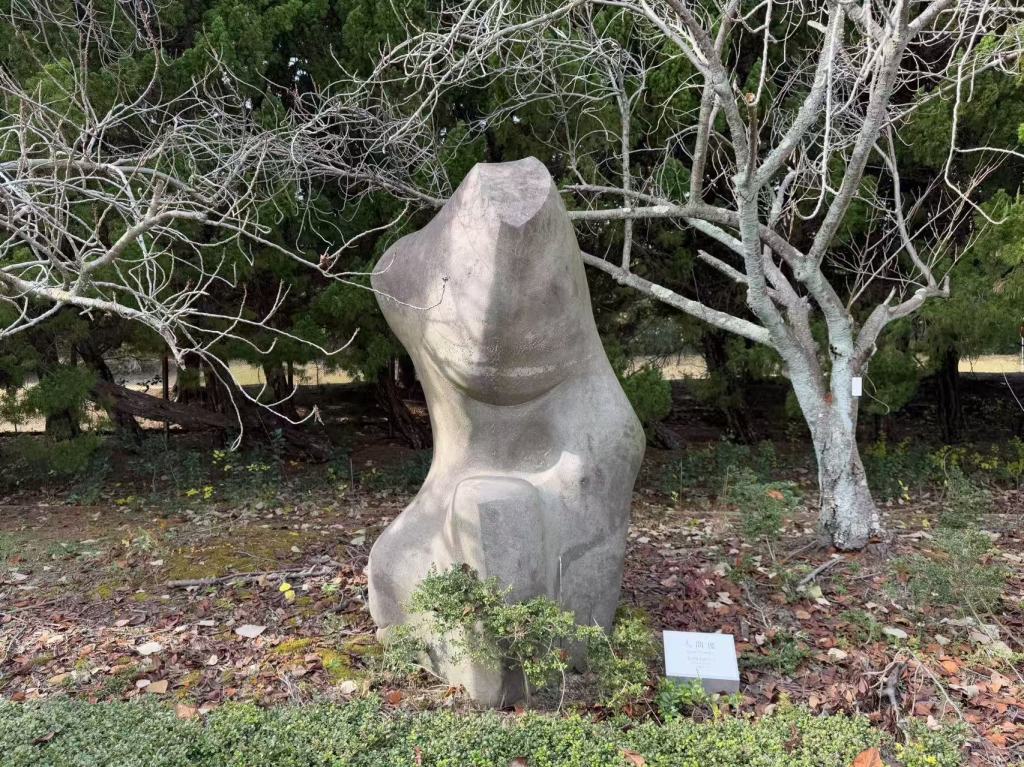
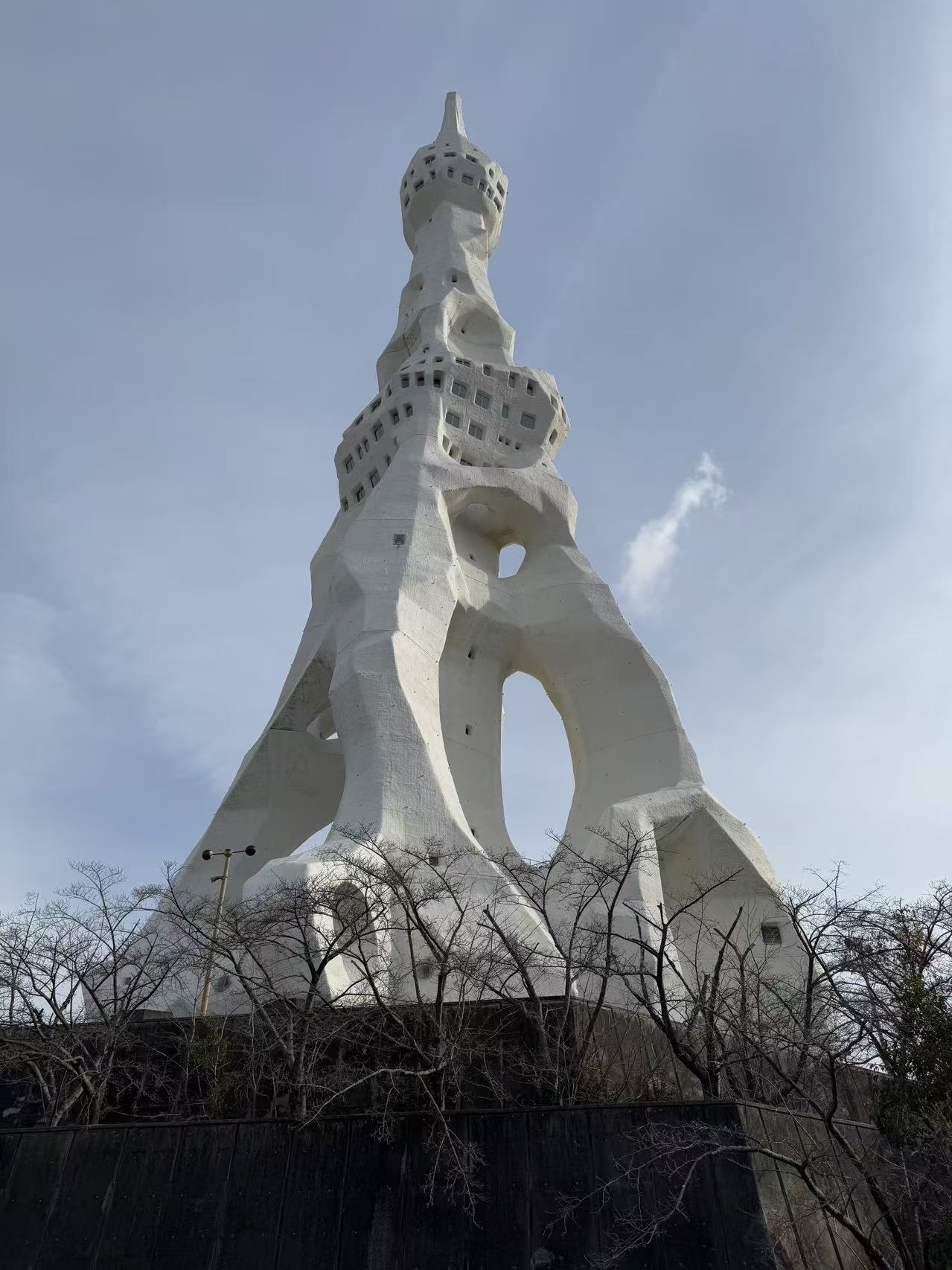
I ascended the stairs to the tower.
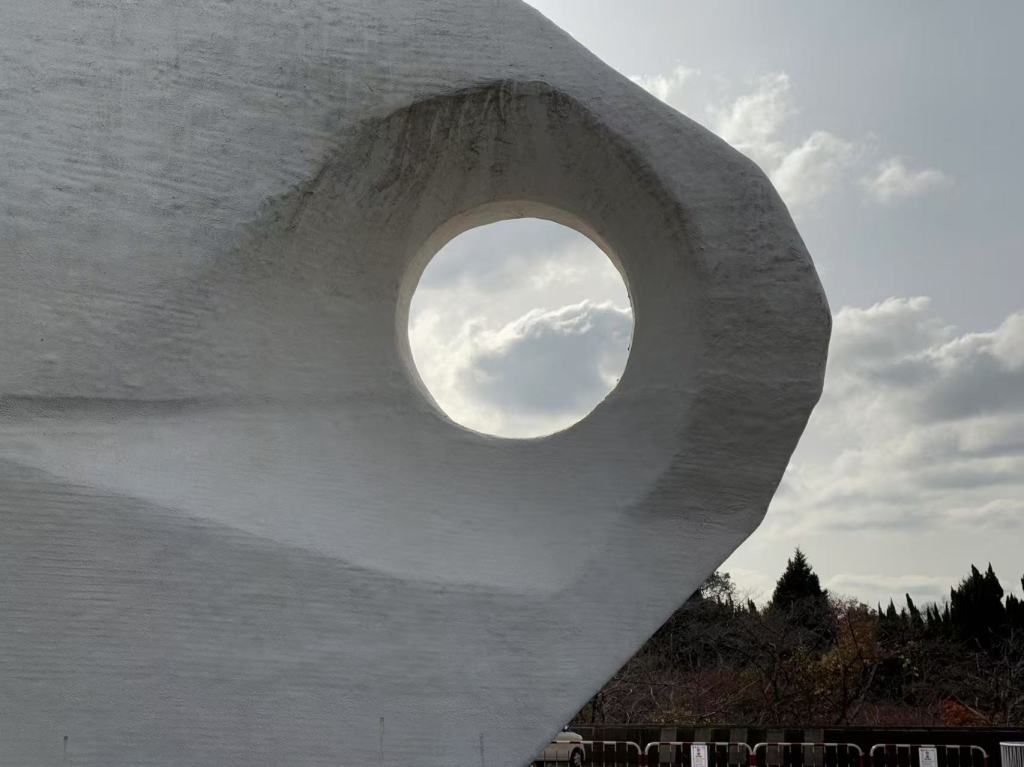
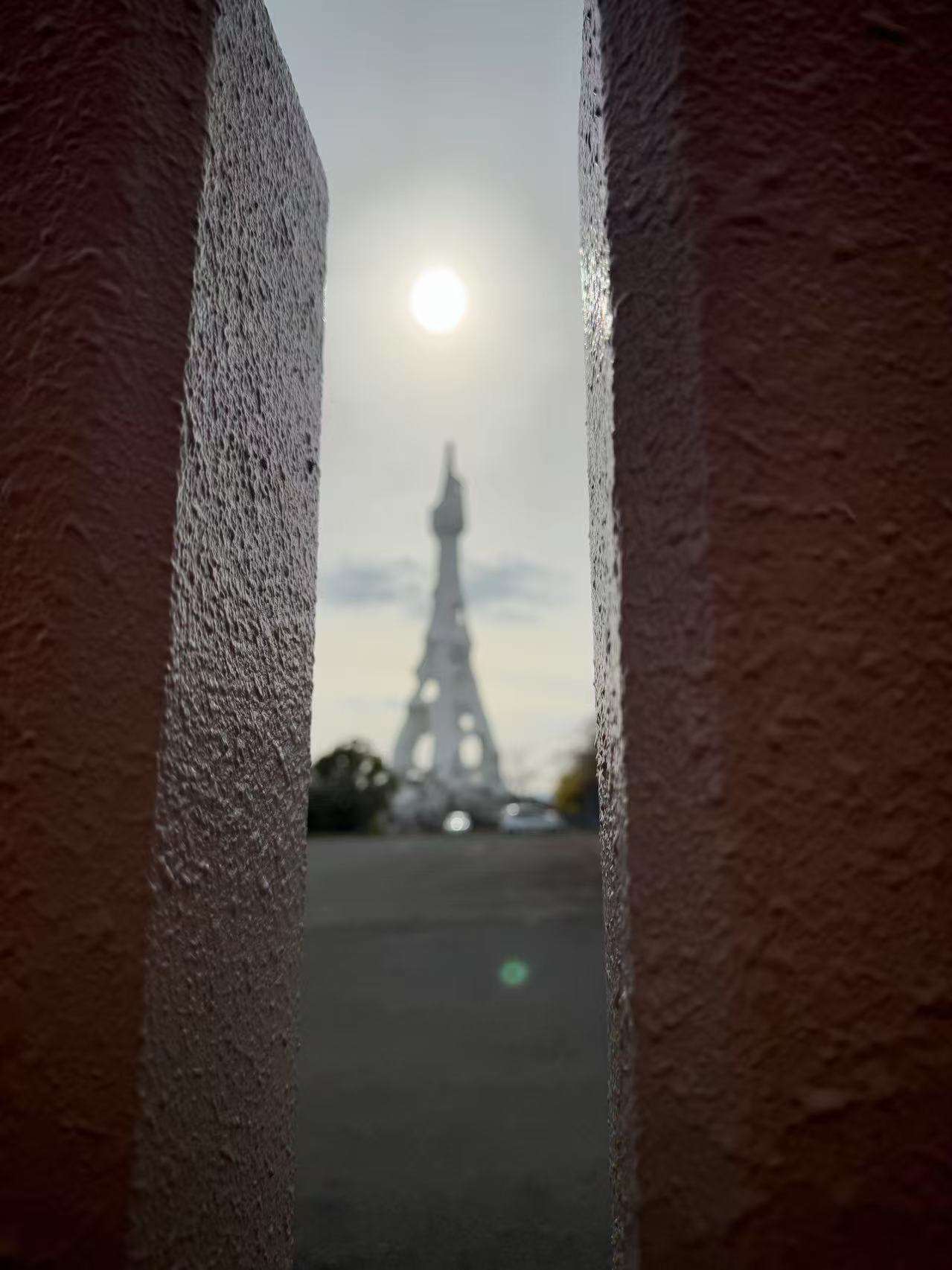
The scale of it was astounding. Never had I seen anything so unique and so large in my life, nothing like it. I stood there for a good five minutes just admiring its grandeur. Then came the realization that I was completely alone, and I made up my mind to walk around the tower. It had such a grotesque geometry which looks a different shape from every angle, reminded me distinctively of the props used in the Japanese Tokusatsu (特撮) films such as the towers in Godzilla or Ultraman. Windows of different sizes were carved into the tower, especially at the middle and top parts of the tower, which shaped like the knots of the elder wand.
Are these windows for independent rooms? Or one giant hollow space? What goes on in there? Do people live up there? How many?
More and more questions crept up to my mind as I tread, a modest automatic glass door was there at the center of the tower’s base. The sunlight’s reflections obscured the view through the glass door. I had one way to go and that’s inside that door.
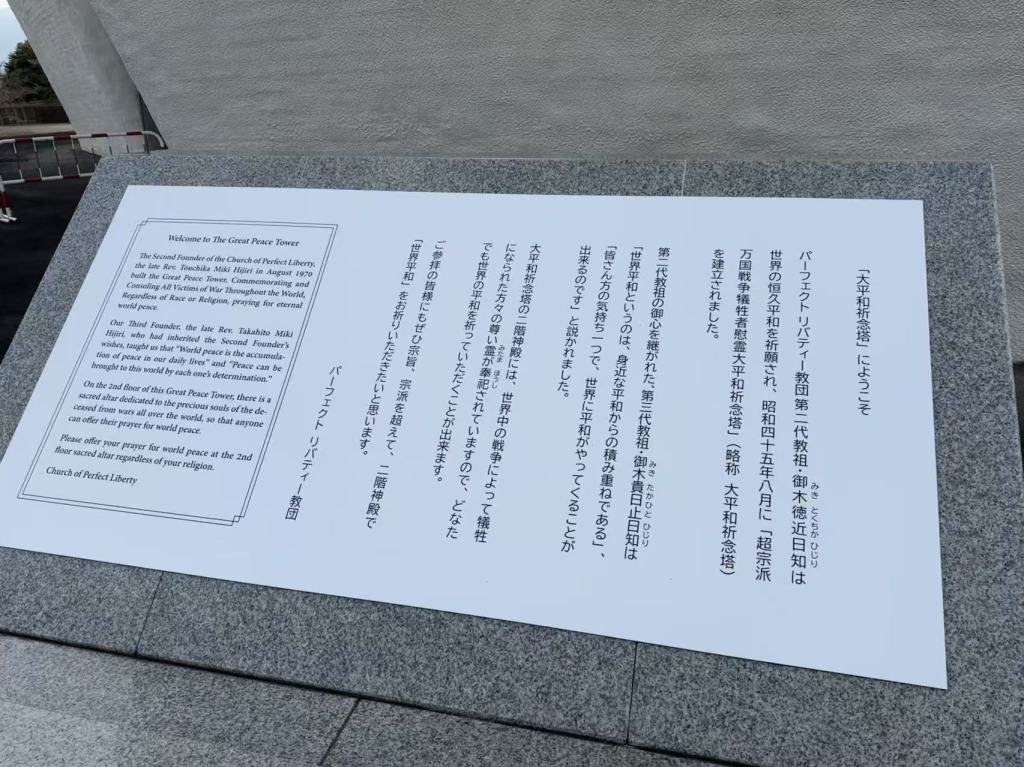
“Welcome to The Great Peace Tower
The Second Founder of the Church of Perfect Liberty the late Rev. Touchika Miki Hijiri in August 1970 built the Great Peace Tower, Commemorating and Consoling All Victims of War Throughout the World, Regardless of Race or Religion, praying for eternal world peace.
Our Third Founder, the late Rev. Takahito Miki Hijiri, who had inherited the Second Founder’s wishes, taught us that “World peace is the accumulation of peace in our daily lives” and “Peace can be brought to this world by each one’s determination”
On the 2nd floor of this Great Peace Tower, there is a sacred altar dedicated to the precious souls of the deceased from wars all over the world, so that anyone can offer their prayer for world peace.
Please offer your prayer for world peace at the 2ndfloor sacred altar regardless of your religion.
Church of Perfect Liberty”
—–Perfect Liberty Kyodan
Into the Glass Doors
I walked to the entrance of the tower. The automatic doors slid open, revealing what’s inside.
There was a table right in front of the opening, almost blocking it. Two middle-aged men in white shirts and black pants sat there expressionlessly facing outward — they had probably been watching me the entire time I was wandering outside. I tensed up quite a bit but did not stop my steps.
As I stepped into the ground-level hall of the tower, the older and thinner of the two men rose to his feet, greeted me, and walked directly over. He had that iconic hasty old man walk: slight forward lean, quick, shuffling steps and minimal arm swing. He wore a pair of glasses.
As long as he engaged me, he offered a tour around the first two floors of the tower. This feels like the routine. Of course, I agreed.
I assumed that photography is not allowed inside and so did not dare to take out my phone to take photos.
There was quite a sizable reception area on the ground floor. The walls were of abstract geometry just like the outside. The middle of the hall was the elevator which goes all the way to the top. My guide told me that it used to be open to visitors to go to the top. But that had seemingly turned the tower to a tourist spot and they didn’t want that, so it was since closed of to the general public. I reckon that was one of the reason why this place is so void of… people. There was also a PL amusement park in the campus which closed up in the 80s.
Some sculptures of different genres were scatter around the hall, with a few clay replicas and early ideation of the tower in one corner. They were made by Tokuchika Miki, the man introduced. Whenever after he brings me to a new grotesque statue and introduces the history of it and how its made, I would then pretend to be appreciating it for a minute or two. But really I was just soaking in the atmosphere more than anything. It stroke me that the whole exprience on the PL grounds were not very different from an art exhibition, just one that is too large, too empty, and too in the middle of nowhere.
I detected the slightest impatience in him, and resolved to hasten up. He led me to the elevator. There was metal plaque on the wall, an overview of the floors of the tower. I don’t remember the exact number of floors there were, perhaps around 13. He pressed the elevator button as we awkwardly waited. As we boarded the elevator, he asked me where I was coming from and why did I visit this place, another awkward exchange. The ride to the second floor took a long time.
The Shrine
Out of the elevator and around the corner, emerged the tower’s shrine (神殿). It was just as unusual as any other, a striking, enigmatic structure of metal and light. Its flared walls rise with solemn precision, drawing the eye toward a central red core that glows with quiet intensity. Above it, a golden emblem (usually the core to Japanese religions, new or not) hangs like an unblinking eye, suspended in silence.
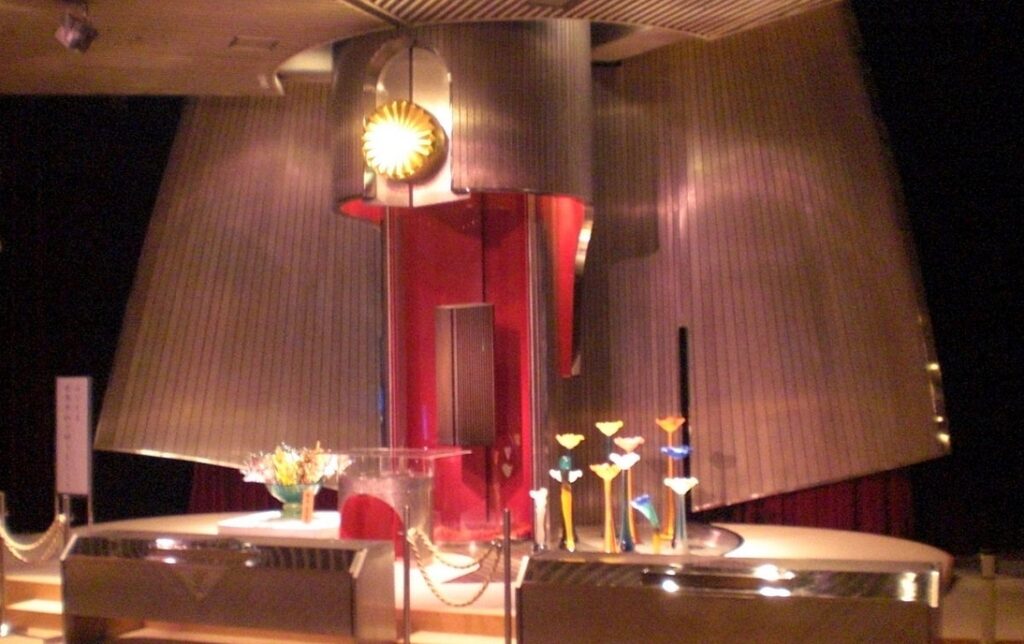
It was said that the names of those who died in wars worldwide were stored in the form of microfilm in the shrine, where the souls of war victims were enshrined. The man introduced me to the plaque on the opposite wall to the shrine, where the doctrines of the PL Kyodan (PL処世訓21ヵ条) were carved. “Life is Art” (人生は芸術である) was the first one of them. He mentioned that earlier in the year, some 200 relevant people had come here to pray for the peace of the Russian-Ukraine war. I silently doubted that this small hall could contain that many people. He then lead me to the front of the shrine, told me that I could donate to them by using the enveloped placed there. I ignored the suggestion, then he instructed that I could pray there in some form that was appropriate to me. So then I stood in front, clasped my hands, closed my eyes dipped my chin, and silently prayed for the peace of the human race for a good 3 minutes.
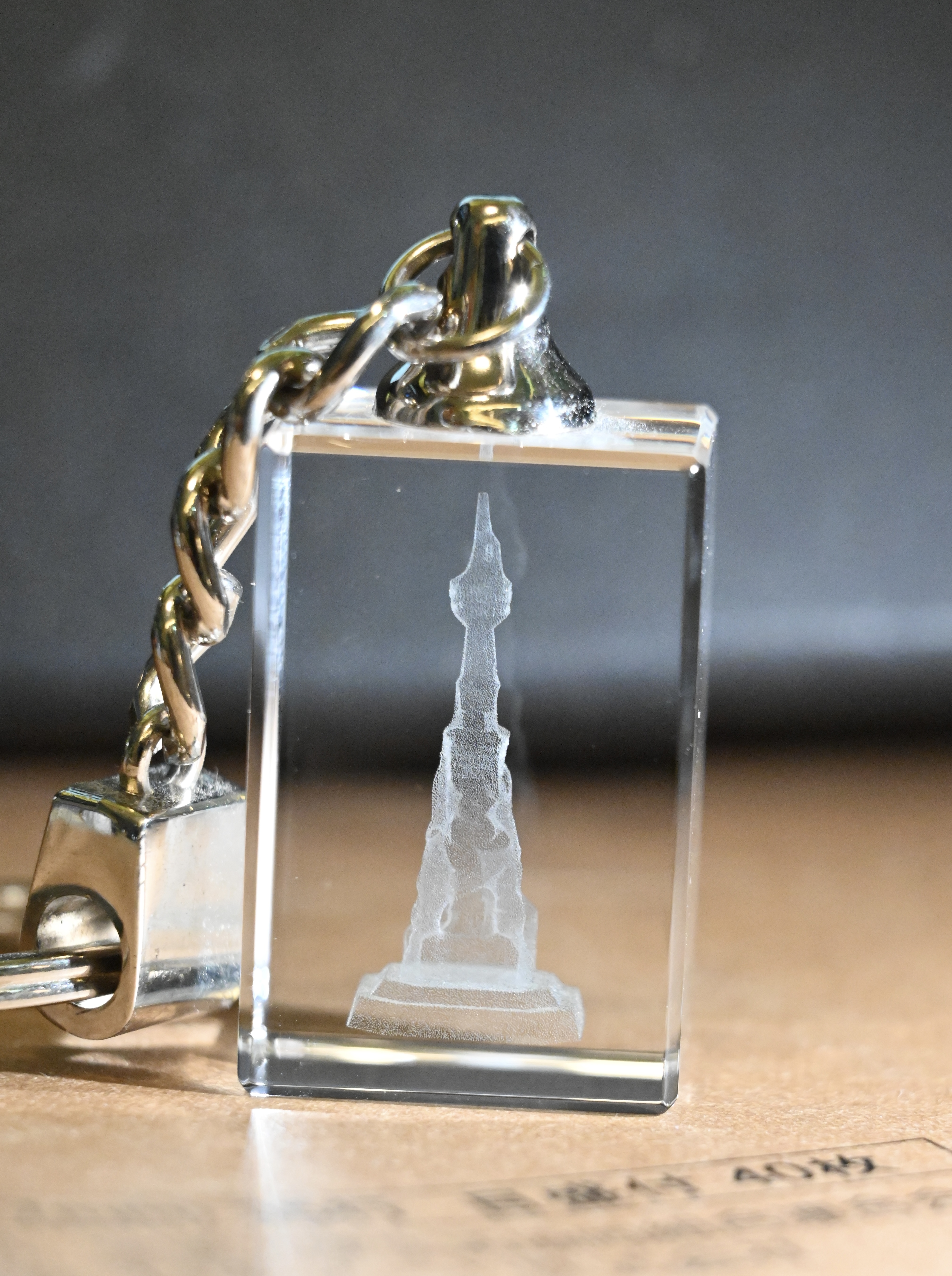
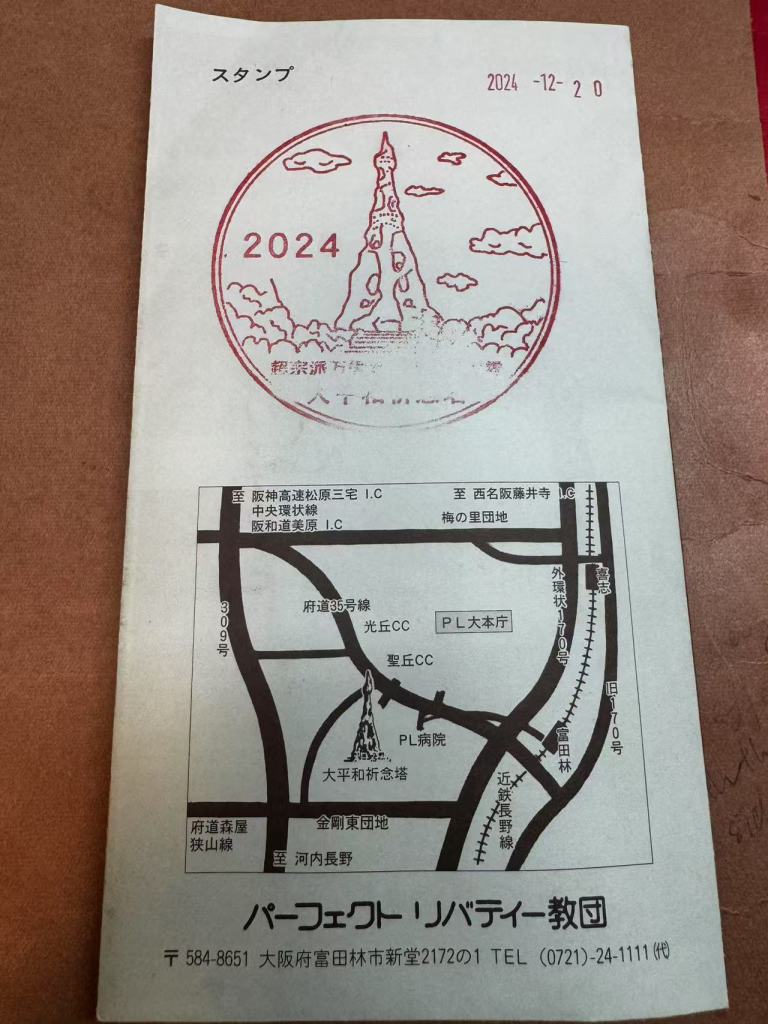
I sensed that he already wanted to get this tour over with, and so I did. After another awkward wait for the elevator and exchange or generic questions, I was released in the first floor. He showed me a few tables where flyers, a wet stamp and a limited number of souvenirs were placed: PL Kyodan themed calendars for the coming year, I considered really hard whether to buy them but resolved not to, for all the images were plain stock images of blue skies and pigeons etc. dotted with the PL doctrines and their Oshienushi’s quotes, and the designs were not enticing at all. There were also a few keychains hung beside. I picked one for 600 yen. I said goodbye, stepped out of the tower and into the autumn wind.
Afterword
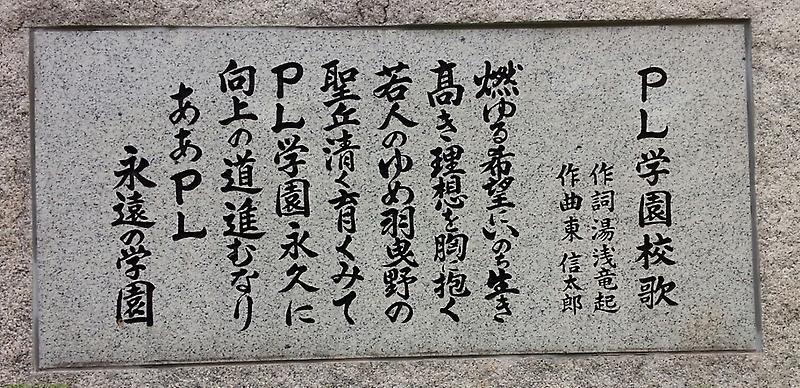
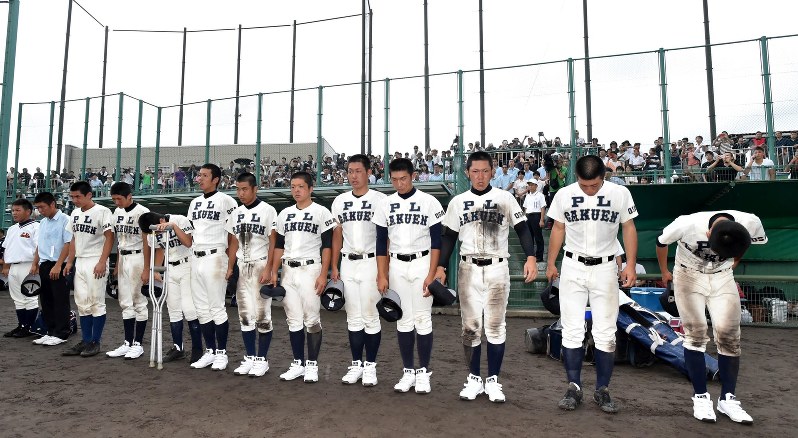
That said, the recent decades of the PL Kyodan have not been entirely barren. For instance, it seems to have international presence especially in Brazil. Also, it has maintained a complete educational system ranging from elementary to high school, including a nursing school, although the number of students and teachers has declined over time. The high school, PL Gakuen Highschool, was once home to a nationally renowned baseball team, particularly during the 1980s through the early 2000s, during the 80s PL Gakuen won the Koshien (甲子園) 7 times. However, the baseball club had faced the risk of closure due to the aforementioned decline as well as scandals involving mistreatment and bullying, and finally did so in 2016. In more recent years, the PL Kyodan has been locally active primarily through its annual fireworks festival (PL花火大会), with tickets priced at a nominal fee. Unfortunately, even that event has been suspended since the onset of the COVID-19 pandemic. Yep, fireworks festivals and a formidable baseball team, just like Bentenshu.
Camera used: iPhone.

You must be logged in to post a comment.