1,808 words, 10 minutes read time.
Foreword
Osaka and the broader Kansai region have been fertile ground for the emergence of many New Religions (新宗教) following WWII. Throughout my life, as if guided by invisible forces, these religions have somehow always had an unexplained presence… I shall talk about this some other time, if such a time ever comes…
For some months prior to the trip, I kept stumbling upon aerial photo videos on Youtube (e.g. 【空から解説】奇妙で不気味な新興宗教10選 ) about these strange religious structures scattered all over Japan. I was entranced, and after awhile, finally decided to visit some of them by myself.
And so, I packed my bag and set forth on a quiet pilgrimage through Kansai, to hidden places where history lingered and untold words waited to be heard.
Tower of the Sun (太陽の塔)
I arrived at Kansai International Airport, Osaka, Japan on a chilly late-Autumn morning. My first stop was the Tower of the Sun in Ibaraki-shi, Osaka.
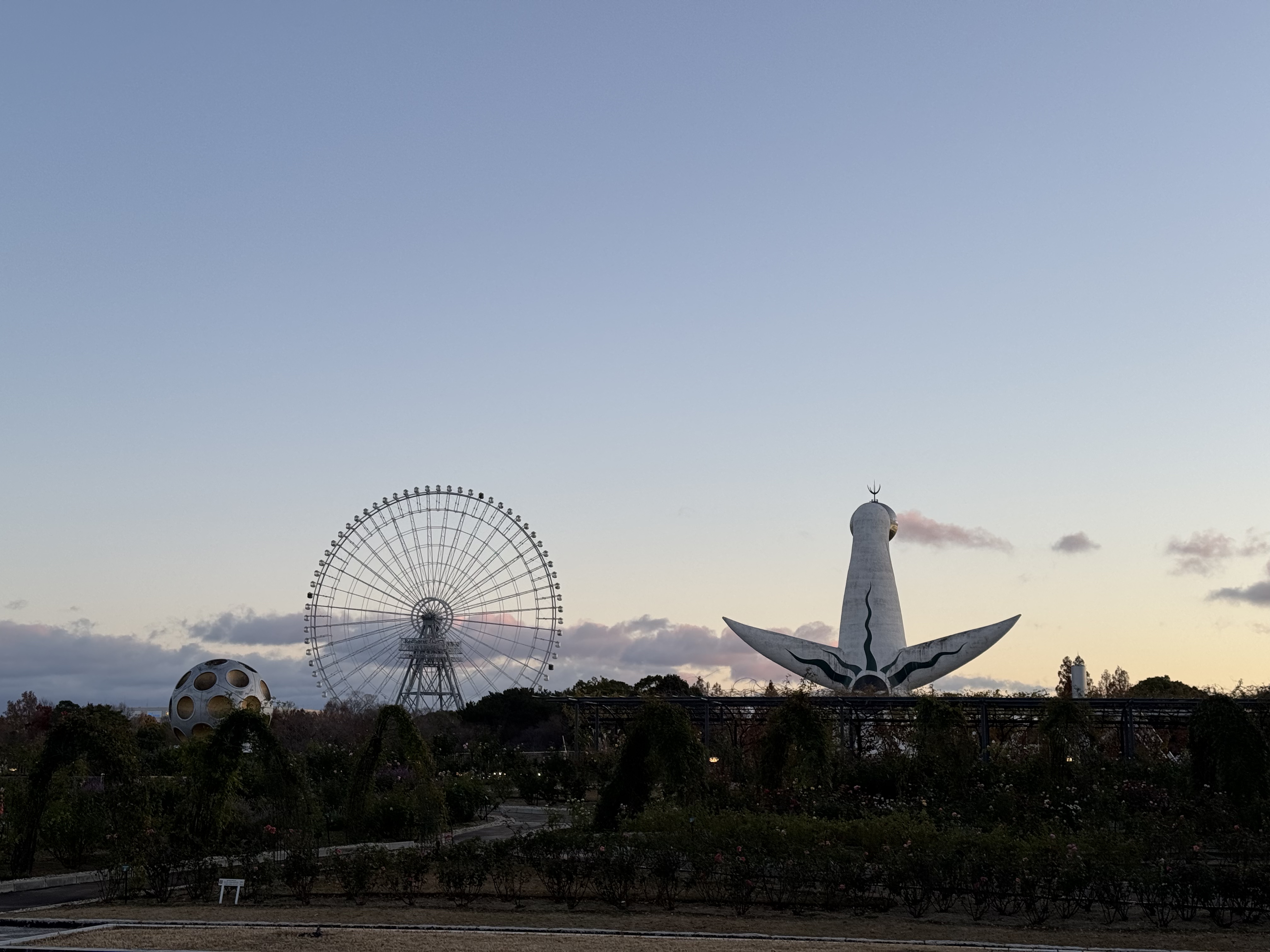
Of course, it had nothing to do with any specific new religion movement, and was rather the symbol of the world expo 1970 held in Osaka (where, incidentally, the coming expo 2025 will also be held). Nonetheless, I always wanted to see this strange unique arms-growing-out-of-it tower in person. It was astounding enough looking at it through a screen, and to think now I was about to stand right beneath it, and even get inside… It was a red-eye flight.
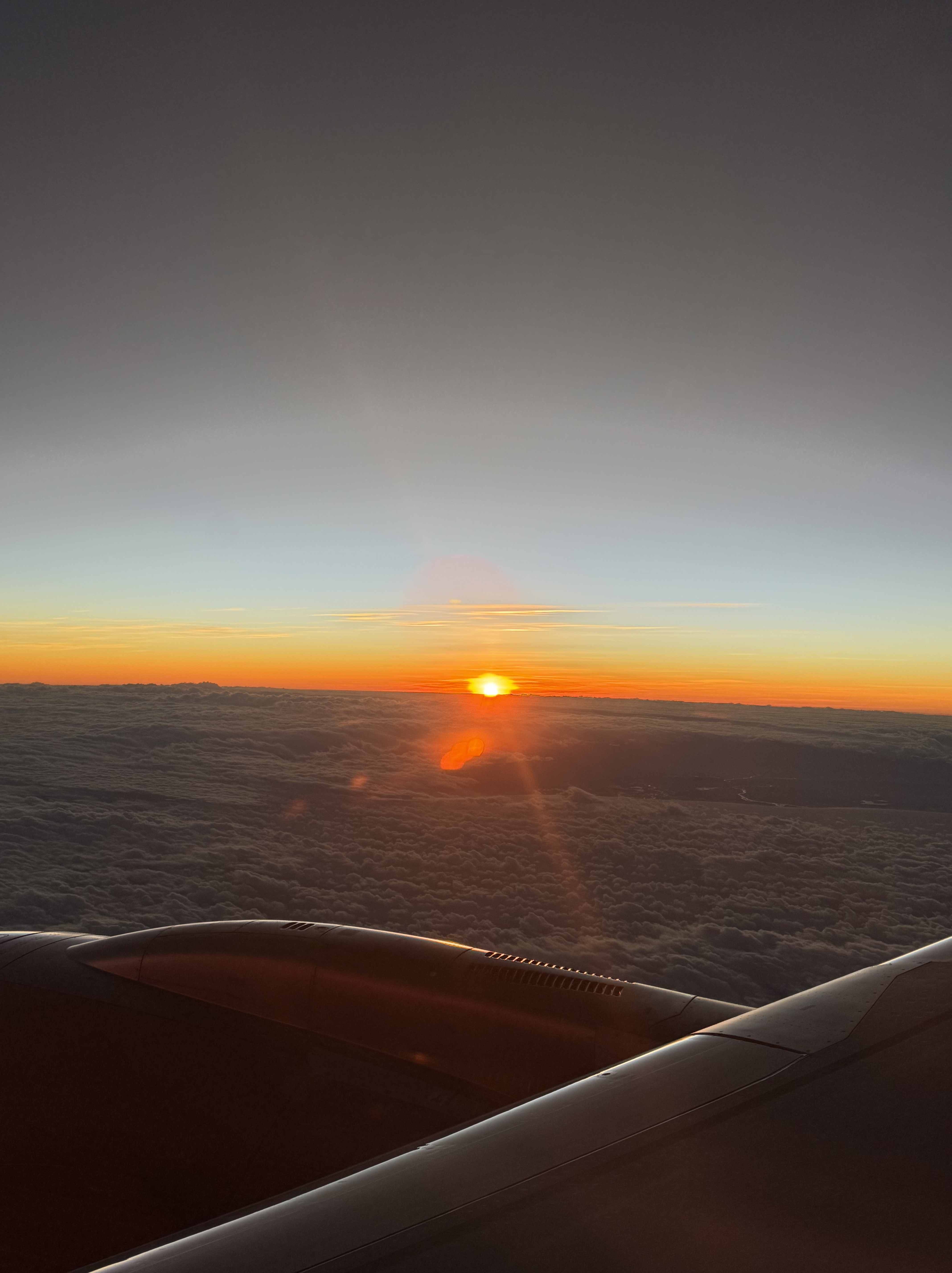
The sunrise from the plane’s window was as glorious as always. Marvelling at the millions of shades of blues and oranges, I thought to myself: this is bound to be a tiresome day…

The Inside
The Tower of the Sun was designed by the late Taro Okamoto (岡本 太郎) who was known for his distinct avant-garde art style.
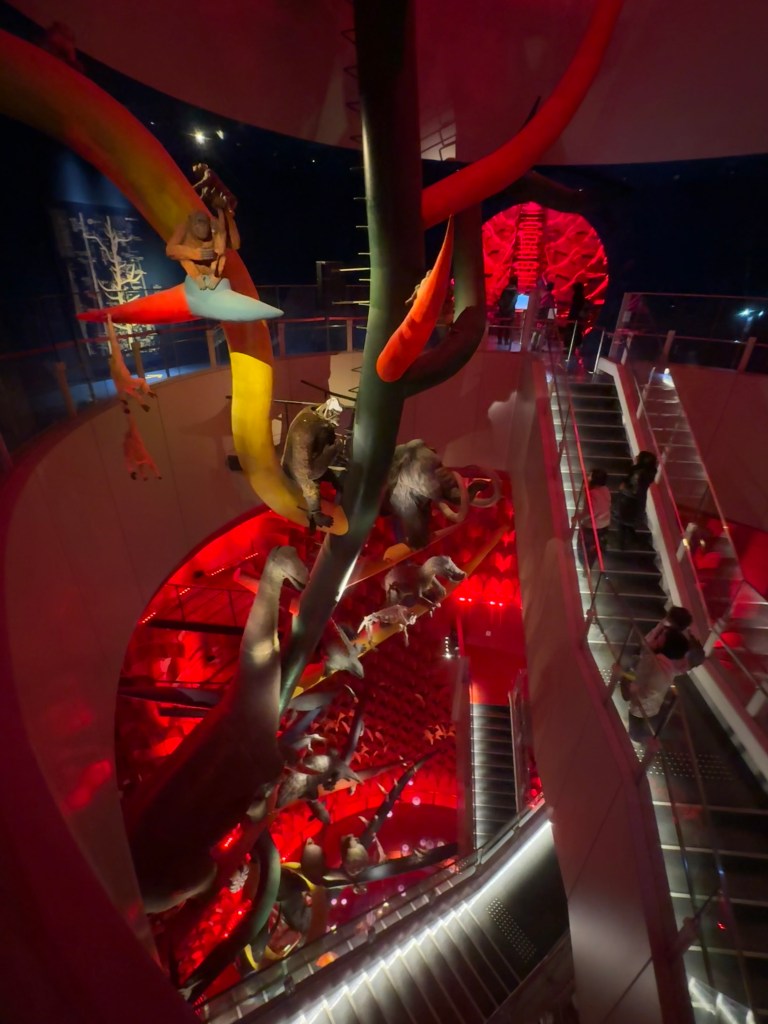
The inside of the Tower of the Sun showcased “the Tree of Life” (生命の樹). Reservation by the previous day was required to visit the inside, and an ticket price was to be paid. I made my reservation months prior and it turned out that there weren’t many visitors at all.
Before entering, I paid an extra ¥500 for a neck phone holder to be able to take photos from on top, it was a slight rip-off. In addition, it required some paperworks which involved filling in my contact and home address… Looked like a result of a number of careless accidents involving phones and heads that had happended before.
Bentenshu (辯天宗)
Bentenshu (辯天宗) is a Japanese New Religion, orginated from Buddhism and created on the year 1952. They worshipped the Benzaiten (大辯才天女尊), a Japanese Buddhist deity originated from the Indian deity Saraswati. It was said that their founder Chiben Omori, the wife of the highest monk of the Buddhism temple Jurin-ji, received a revelation from the goddess Benzaiten. Its main site was also located in Ibaraki-shi, Osaka, rather close to the Expo 70′ park. Although it was open to public, it was not very accessible by public transport.
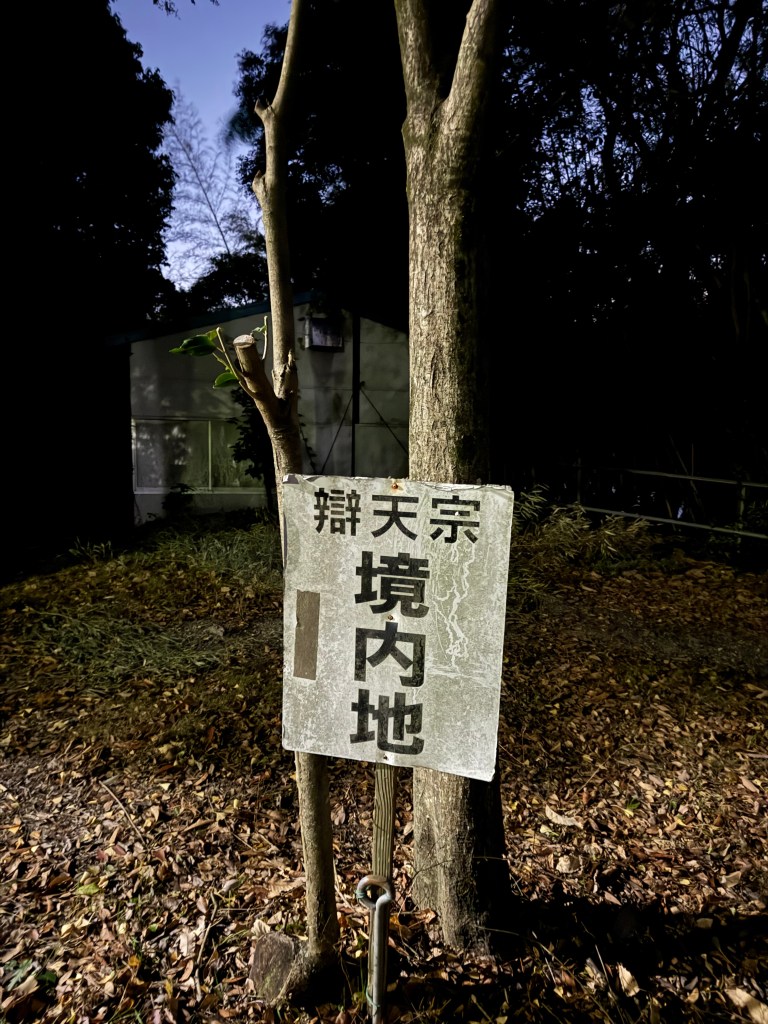
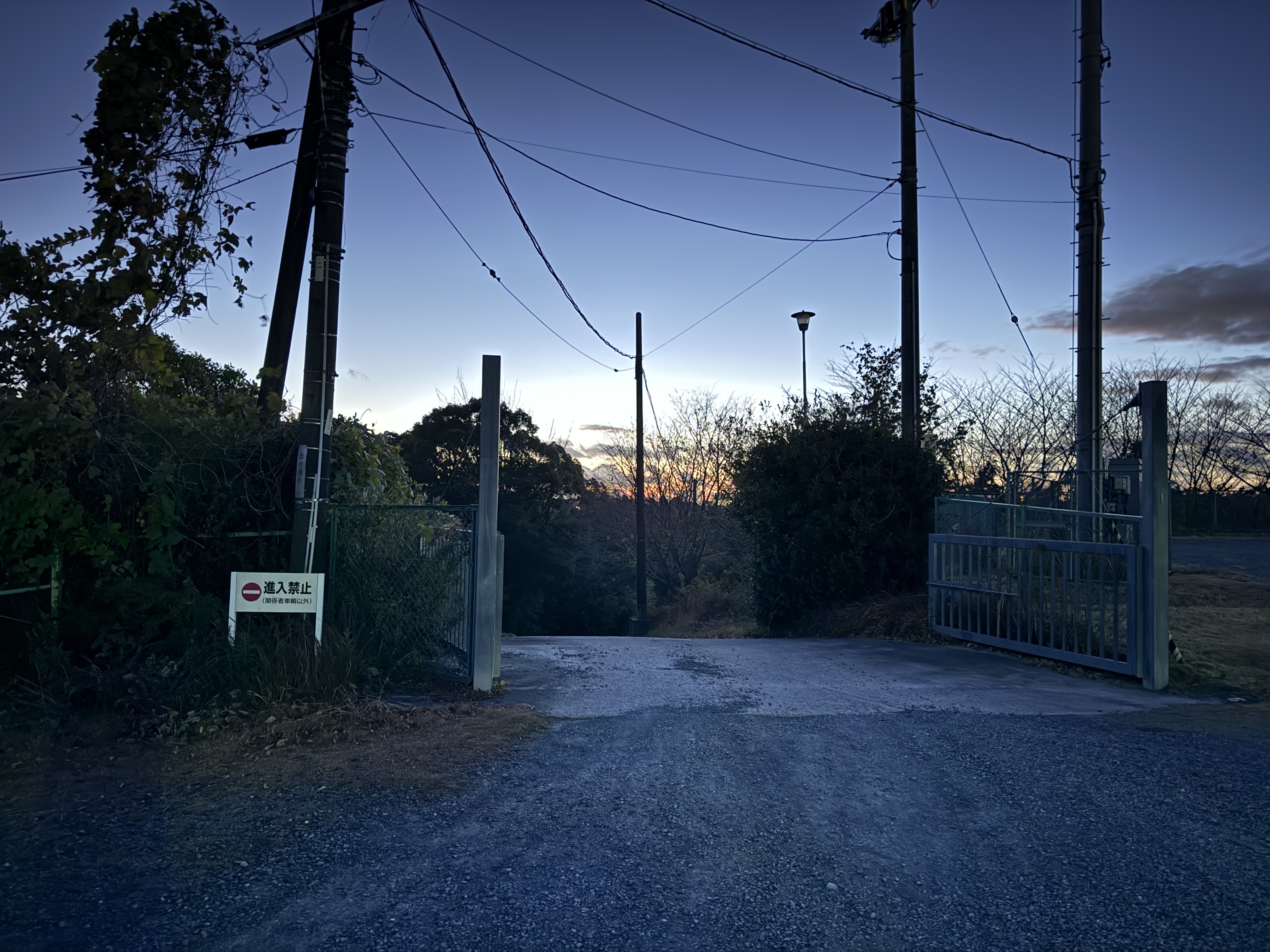
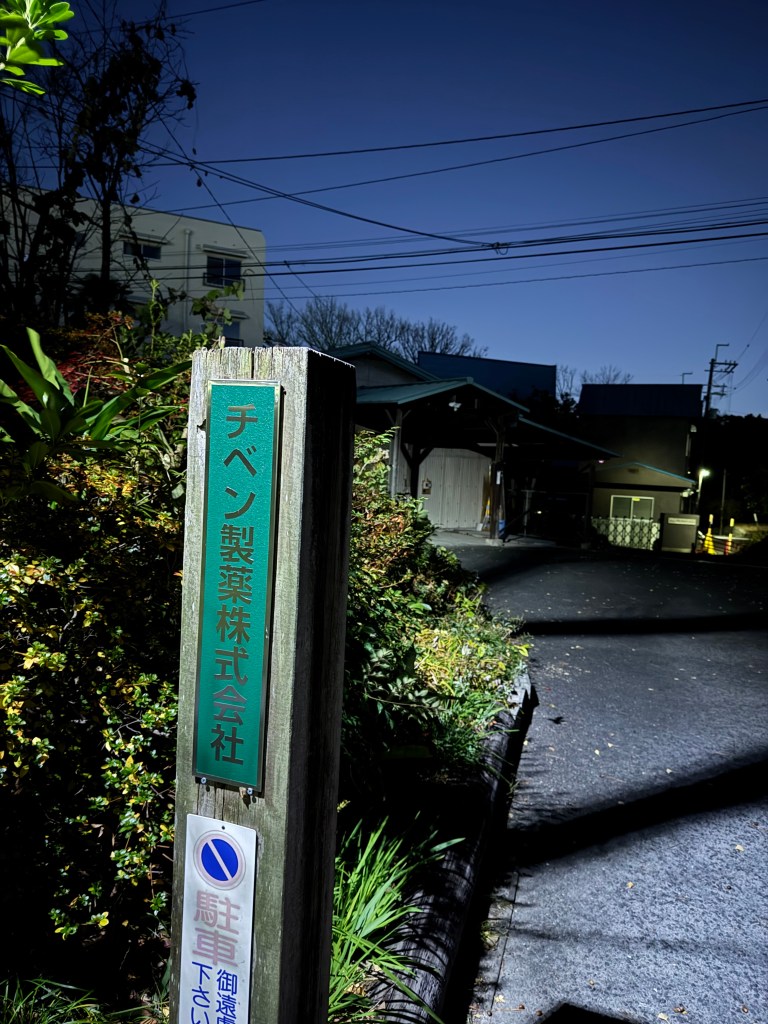
I left Expo 70′ park at dusk and called a taxi. The main roads were conjested because it was the evening peak hours, so we took a route through the alleys, and arrived at one of its side “entrances”. It was a conspicuous hill near the Meishin Expressway (名神高速). There was a stone pillar (see bellow) on each side of the set of stairs up a dark hill. There was no street lamps or any sort of lighting in the area and it was dark and kind of eerie, but thanks to iPhone’s nightmode the photos all turned out pretty good… I put on my head lamp, took a few deep breaths and climbed up the 88 stairs shrouded in the darkness of the dusk.
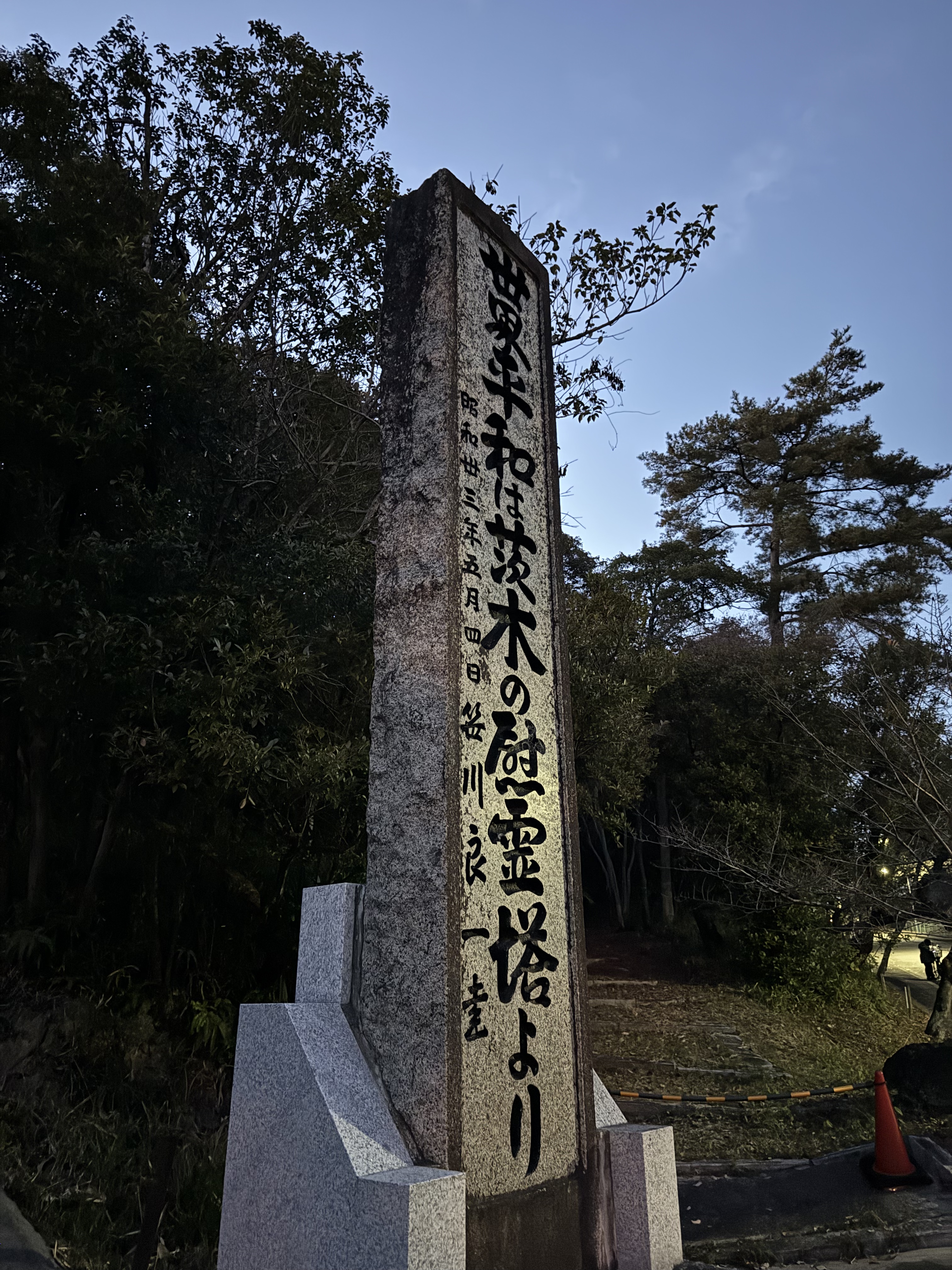
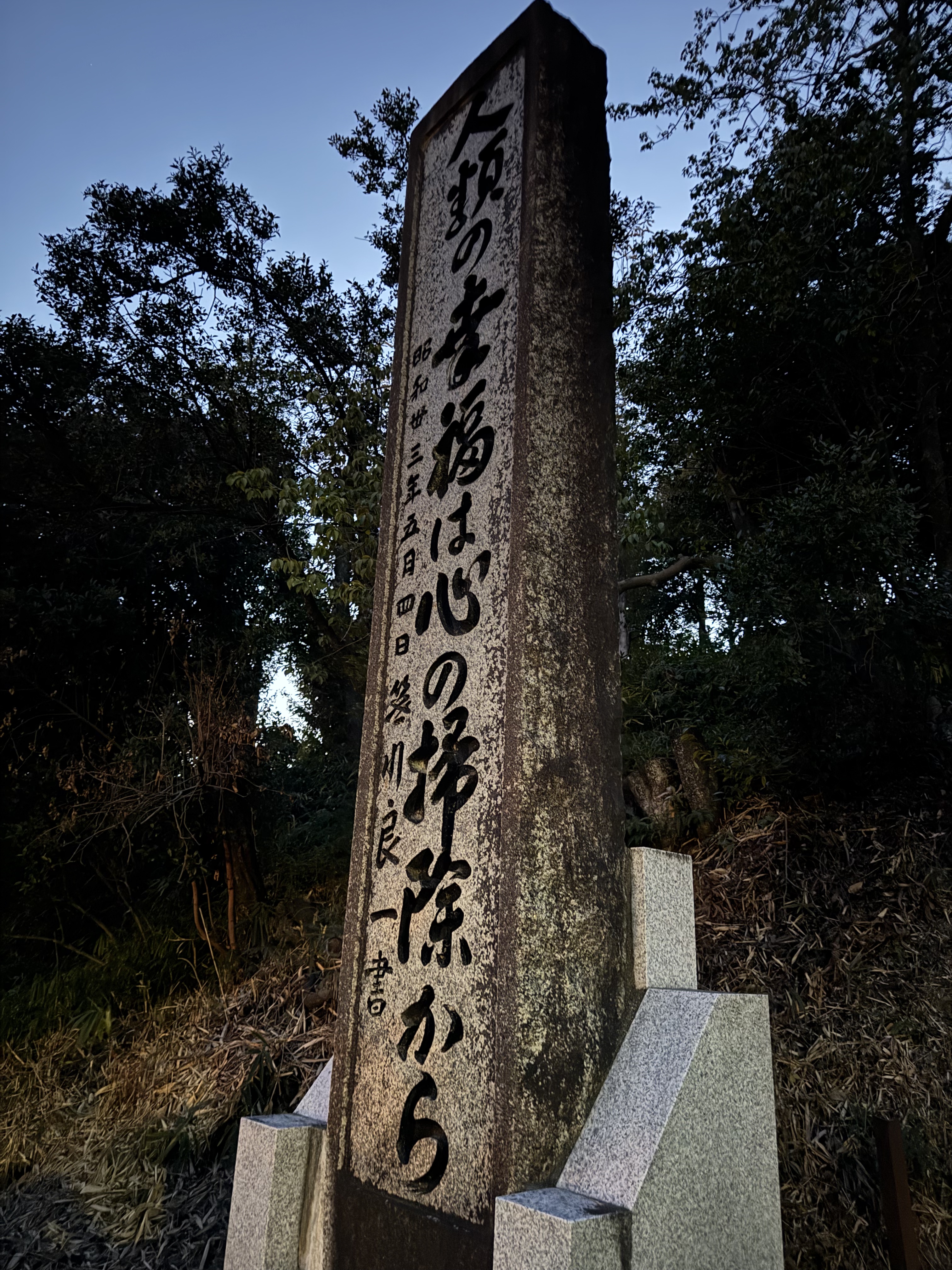
From some internet research, it appeared that famous Japanese far-right politician and post war businessman and philanthropist Ryoichi Sasakawa (笹川 良一), whose motto was “The World As a Family, All Man As Brothers and Sisters” (“世界一家 人類兄弟”), had close connections Bentenshu. He was suspected of war crimes in WWII but was never trialled and was released after the day after Hideki Tojo’s execution. He was a believer and the representative of all believers, and the land and this memorial “tower” were donations by him. There is also a bronze statue of him carry his mother up 785 stairs, somewhere in this site of Bentenshu. His Wikipedia page is definitely worth a read.
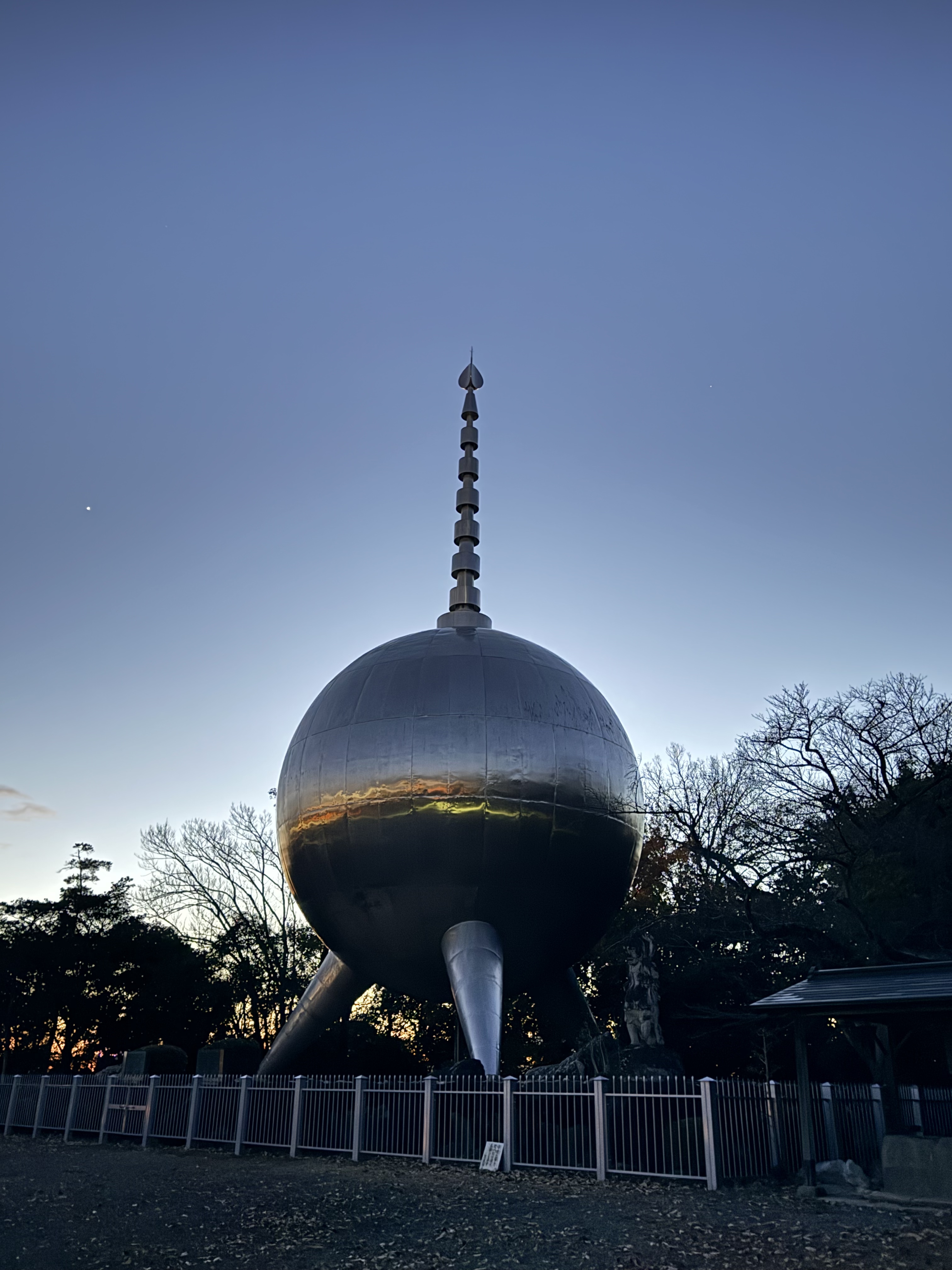
Up the stairs was a clearing covered in gravel, and right beyond that was… a UFO.
A real-life “UFO” loomed under a darkening sky, enveloped by leafless trees. This striking object was like no other memorials I have ever seen anywhere else. A large metallic spherical body raised on three legs, resembling a spacecraft or scientific observatory. The smooth, reflective surface of the sphere caught the evening light beautifully, creating enigmatic reflections of the surroundings. A tall, segmented antenna-like spike extended upward from the top of the sphere, adding to the futuristic appearance. This structure was fenced off and beside it on the right was a chozuya (手水舎), a hand-washing stone basin commonly found at entrances to Jinja and Temples. I walked to the feet of the tower and before me were two brozen plaques, in English and Japanese.
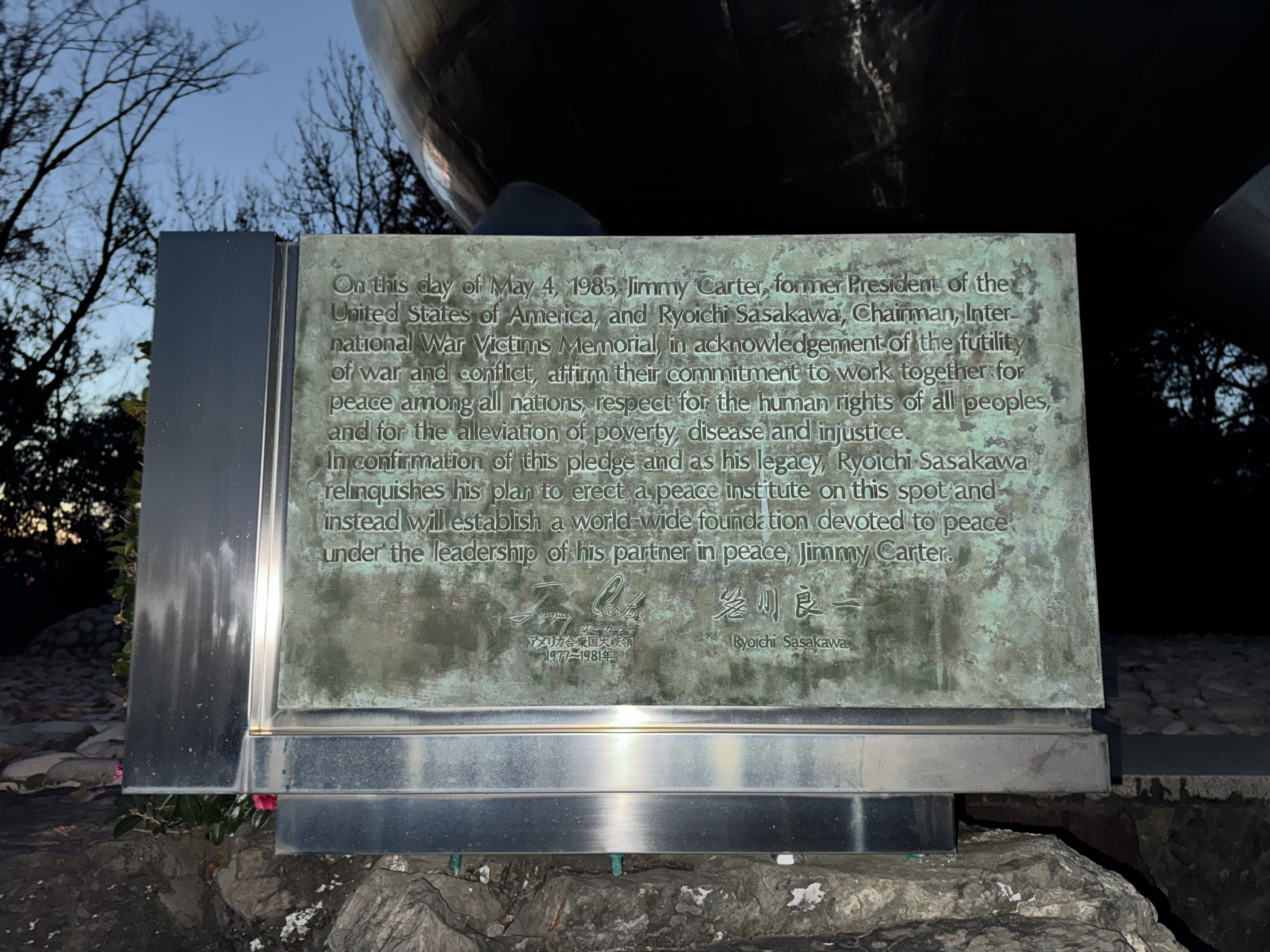
“On this day of May 4, 1985, Jimmy Carter, former President of the United states of America, and Ryoichi Sasakawa, Chairman, lnternational War Victims Memorial, in acknowledgement of the futility of war and conflict, affirm their commitment to work together for peace among all nations, respect for the human rights of all peoples,and for the alleviation of poverty, disease and injustice. In confirmation of this pledge and as his legacy, Ryoichi Sasakawa relinquishes his plan to erect a peace institute on ths spot and instead will establish a word-wide foundation devoted to peace under the leadership of his partner in peace, Jimmy Carter.”
It turned out that this memorial was built more or less solely for Jimmy Carter’s visit here at Bentenshu.
Yes, the former US president Jimmy Carter, side-by-side a far-right Japanese politician and suspected war criminal, visited a UFO-shaped peace memorial he built for Carter’s visit, hidden on the hills of a buddhist Japanese new religion in 1985. Well, this was sure as hell a real event and was well documented. A lot could be said about the visit, but it was nevertheless one of the many fascinating combinations of events in human history.
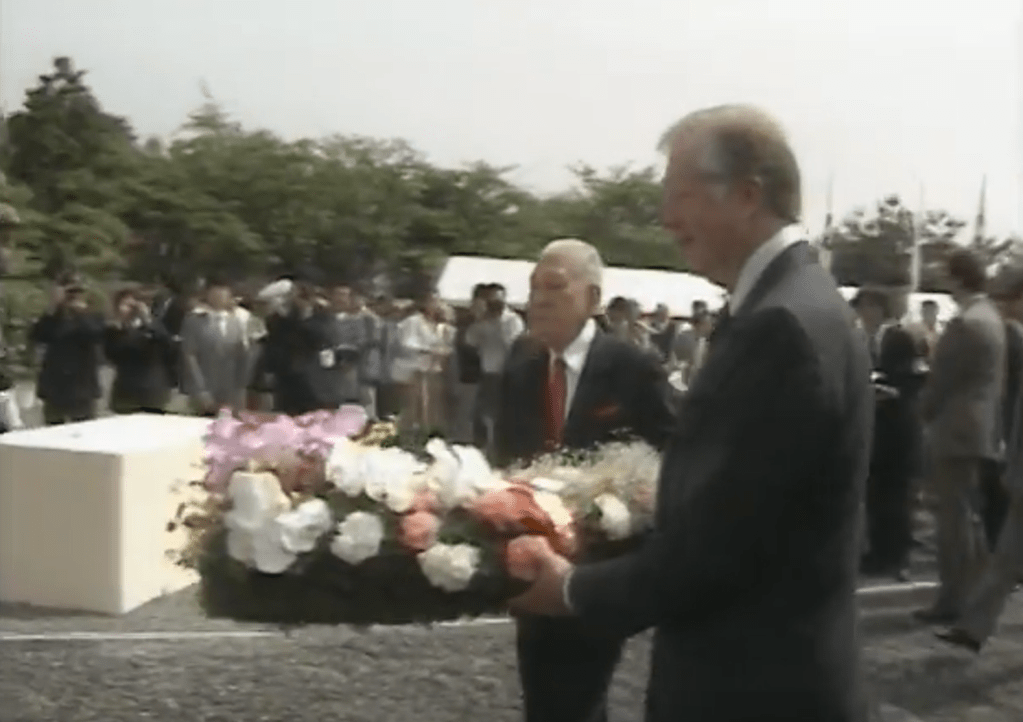
Notably, Carter also visited the Hiroshima Peace Memorial Museum in the same visit to Japan, the first former US president to do so.
Heading Deeper
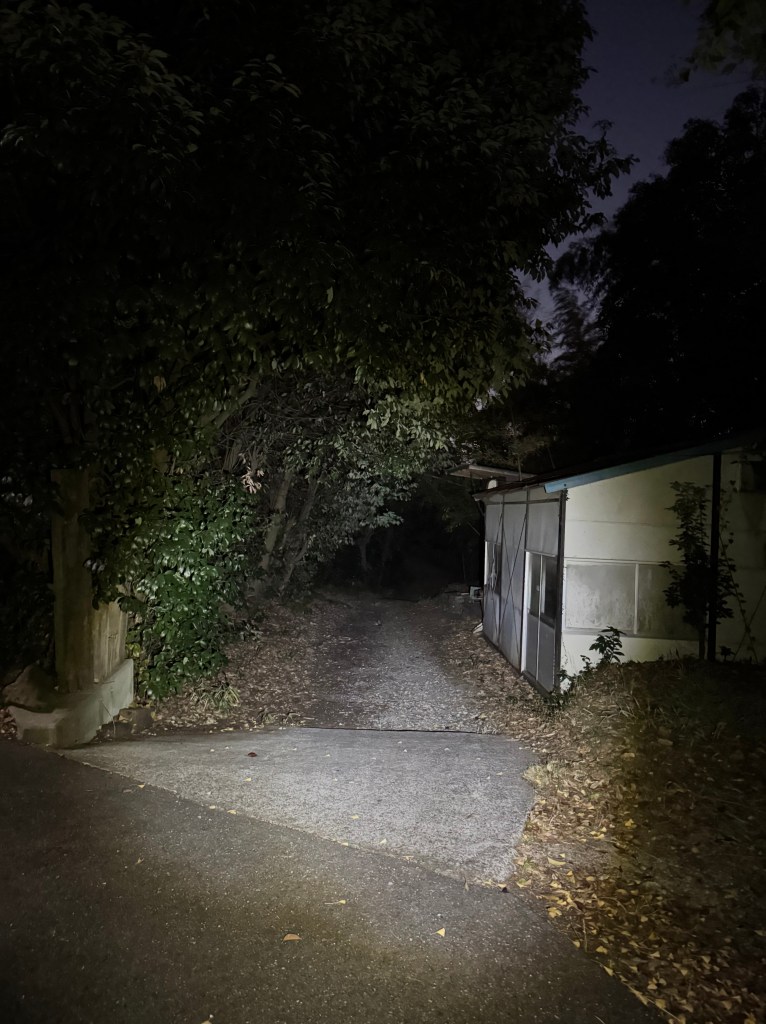
I followed a pitch-black path into the forest and further into the Bentenshu grounds. Although it was supposingly open to public, it certainly did not give out that atmosphere. The ground was covered in fallen leaves and I could feel presences in the darkness where my headlamp could not reach. I hastened my footsteps.
Bentenshu was locally known for two things: their annual fireworks show (茨木辯天花火大会) which was still going on every year, and their affiliated high school Chiben Gakuen (智辯学園), which earned their fame from winning multiple times in the national baseball tournaments (甲子園).
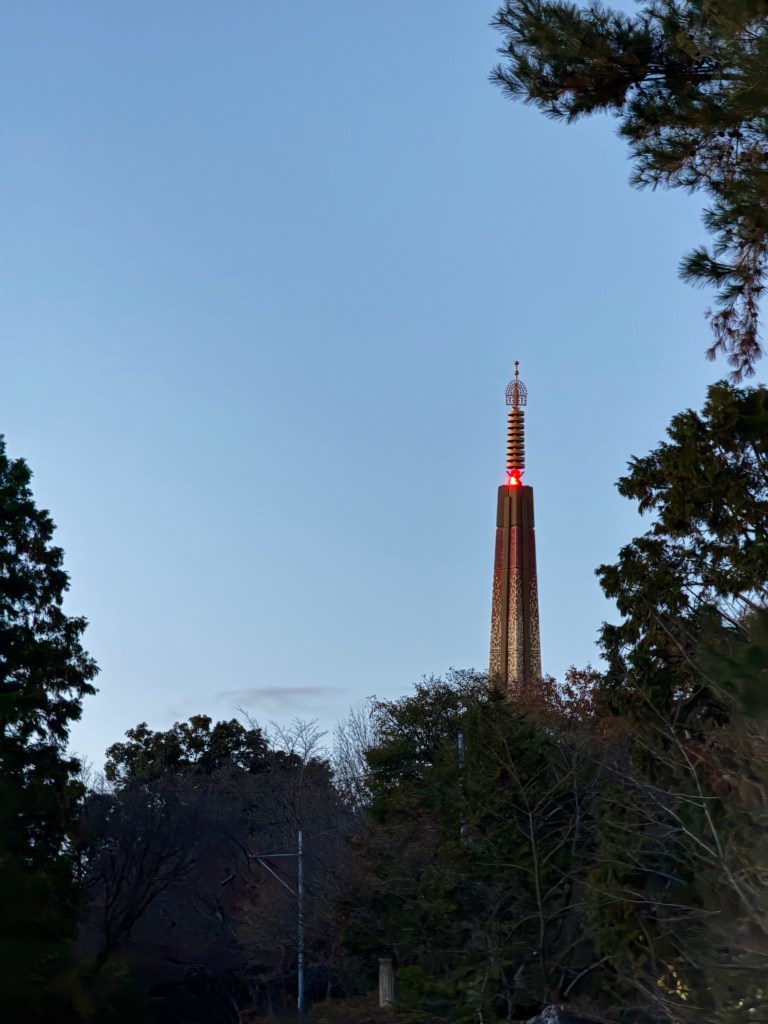
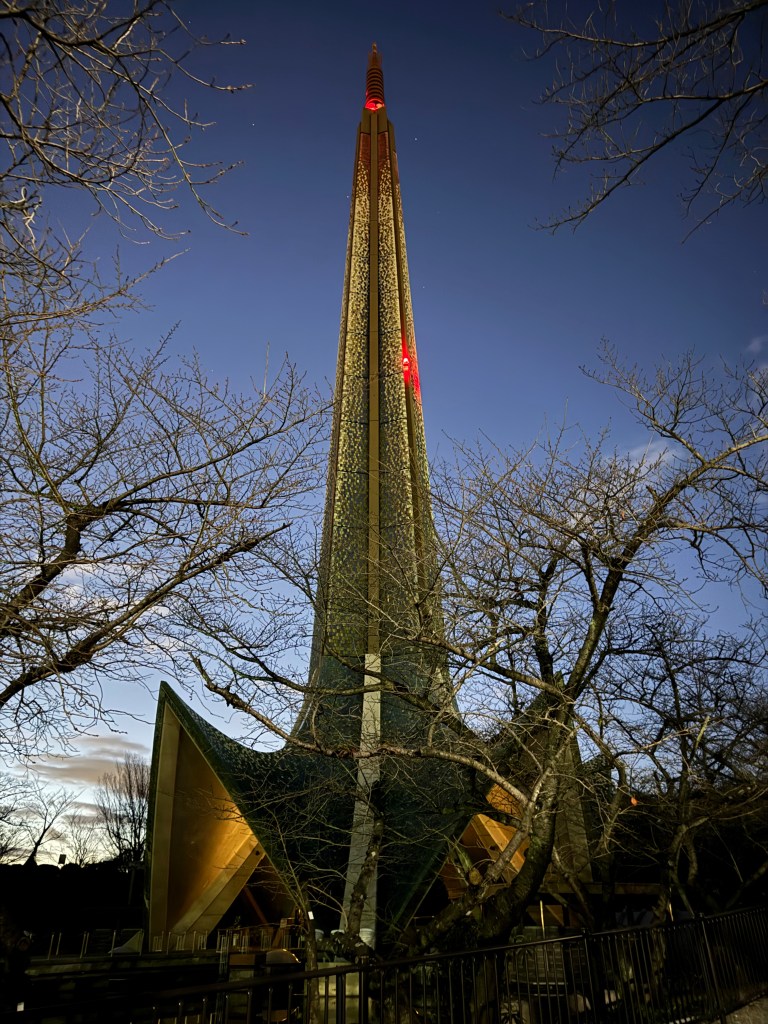
After a few minutes of darkness, I reached the foot of the Mizuko Kuyo Tower (水子供養塔). Like the sphere, it too had a striking and futuristic design, featuring a tall, slender spire with intricate patterns on its surface. Its architecture resembled a combination of modern aesthetics with elements of traditional buddhist structures. The base widened symmetrically, supported by four curved, dramatic arches that could be more frequently seen in Thai and Cambodian temples. Red lights near the top added a unsettling touch and all the while made it visually impressive against the night sky.
A mizuko (水子) in Japanese means a prematurely dead infant. It can be miscarriage, stillbirth or abortion. Mizuko Kuyo is a common Buddhist ceremony in Japan, to pray for and remember one’s child that had prematurely perished.
The Mizuko Kuyo Tower stoods at a height of 73 meters. It was tiled with 25,000 tiles shaped like infant faces. It had a basement, where memorial ceremonies also take place. The ceremony itself costs 10000 to 30000 Yen depending on the extent of it.
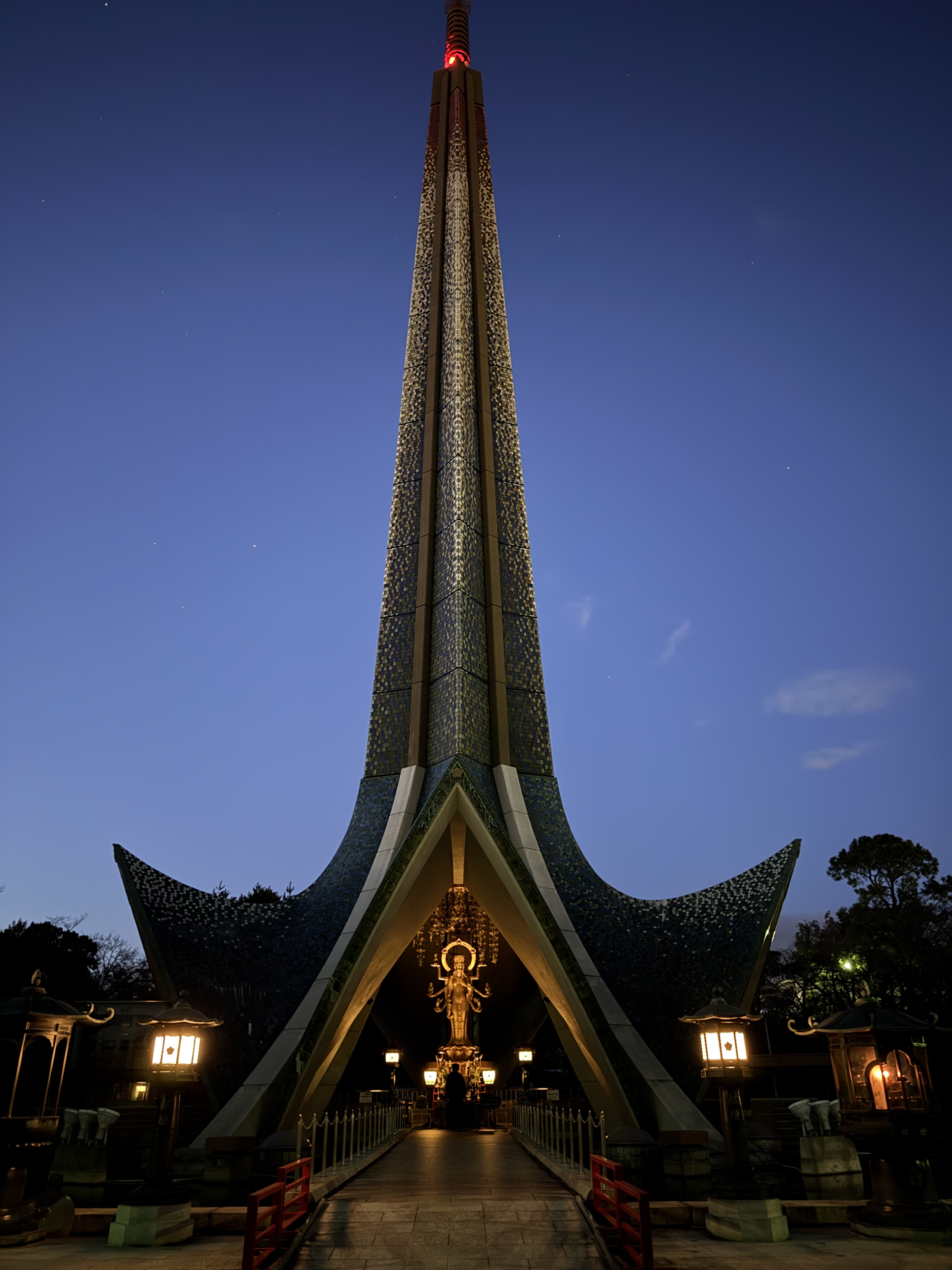
As I was taking the pictures of the Mizuko Kuyo Tower from the front, I made my first encounter in the Bentenshu grounds. I didn’t notice him doing the ritual there at all, not until he approached me. I was taking the photos while kneeing and maybe that was why he greeted me and asked if he was disturbing me, seemingly taking my posture as praying to the tower. I said I was okay, he hestitated a bit but walked away to his car parked nearby, and that was that. Close to the tower was the main building of Bentenshu, Meioji (冥應寺), where the statue commemorating Sasakawa for his filial piety stood outside. I did not get closer to the building. It too was open to public and held religious events often.
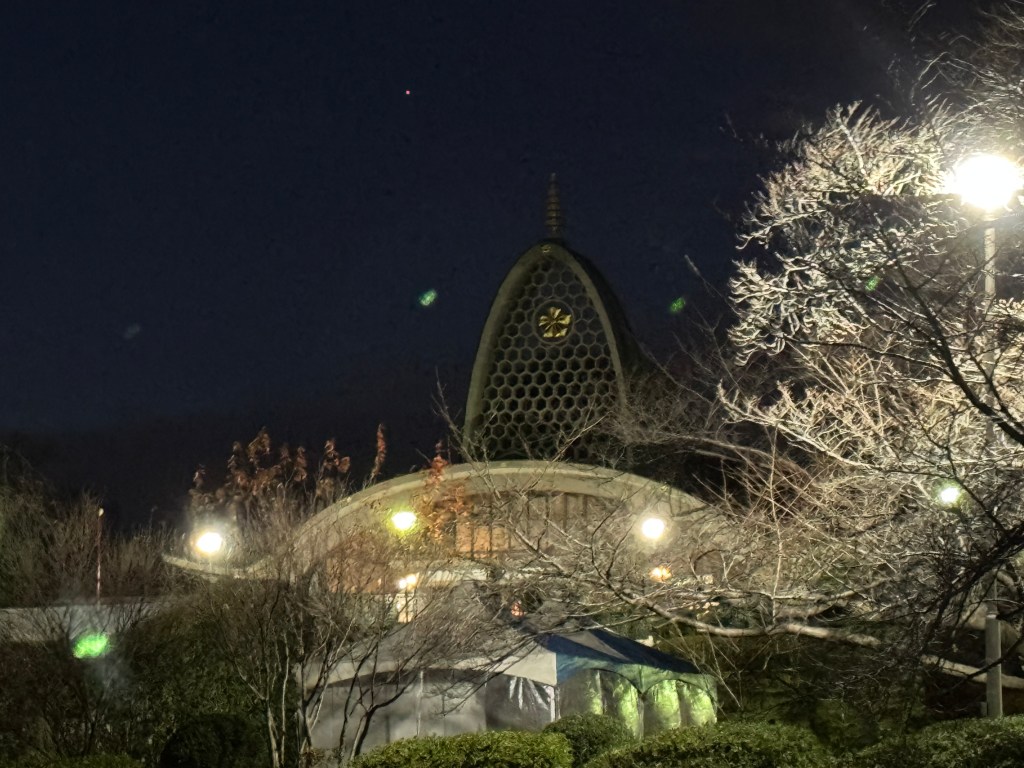
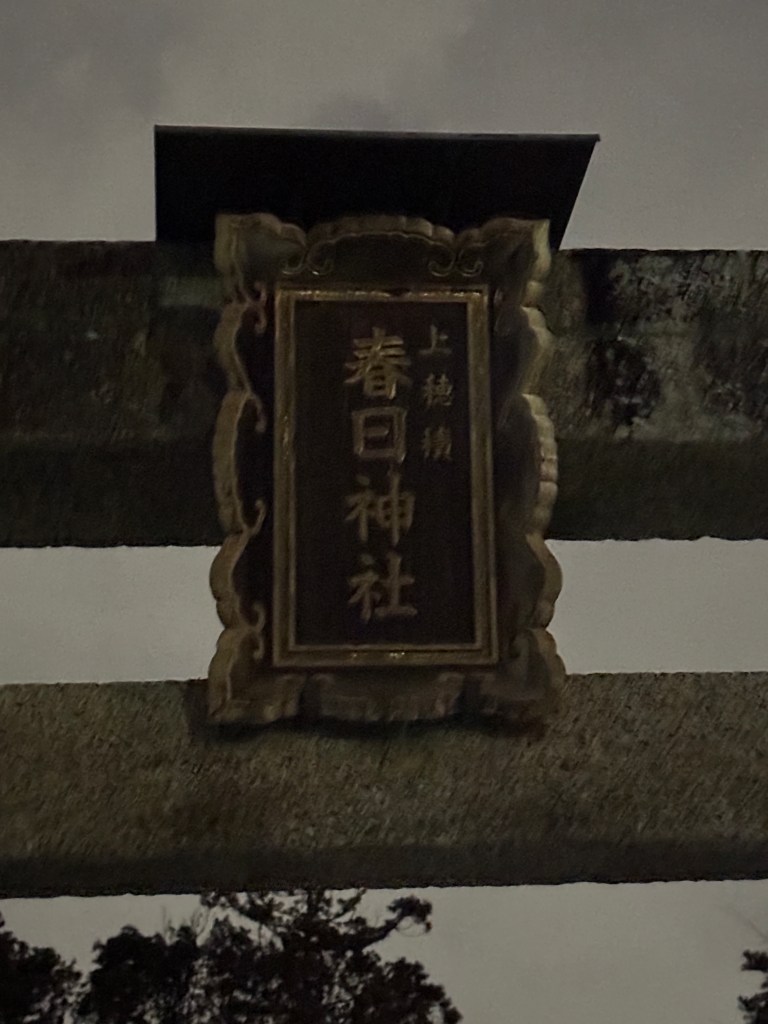
I decided it was time to head out, and took another (equally pitch dark) road out of the Bentenshu grounds. After 20 minutes, I re-emerged into a dim road leading to the highway in the middle of nowhere and ended up calling for taxi again. Nearby was an empty Haruhi Jinja, which was well-lit as hell. How neat was that?
Camera: iPhone.

You must be logged in to post a comment.